

Fracking compared to slavery at debate

But Josh Penry defends the practice during oil and gas forum

4/25/2014


By Peter Marcus

“Slavery had a lot of economic benefits, but it had an ethical problem. Bringing fossil fuels is an ethical problem…”

“Most of the water of the world is… groundwater. What we’re doing is destroying the future in a very real sense.” 


Environmental activists walked into the lion’s den on Monday night, supporting the notion for a ban on hydraulic fracturing at a meeting of the conservative-leaning Centennial Institute, which favors the controversial oil and gas exploratory process.

The debate included activists Phil Doe and Wes Wilson of the progressive organization, Be The Change.

But the activists did not shake in the face of opposition. In fact, they doubled down, comparing fracking to slavery.

“Slavery had a lot of economic benefits, but it had an ethical problem,” Wilson slammed his opponents. “Bringing fossil fuels is an ethical problem…”

On the other side of the issue were former Sen. Josh Penry, a Republican with oil and gas advocacy group Vital for Colorado, and Simon Lomax with Energy In Depth, an arm of the Independent Petroleum Association of America.

Penry appeared stunned, infuriated that his industry would be compared to the practice of slavery.

“You hear cancer, earthquakes, birth defects, flaming faucets, and now, a comparison of 110,000 people who are working every day… making a good living for their families, as being akin to slavery…” decried Penry. “The slavery thing to me shows me the lengths to which they’ll go, and that’s why in the end, the longer the debate goes, the more confident I am… this will be a non-debate, fracking and oil and gas development will be a large part of our community…”

Former Sen. John Andrews, a Republican who is director of the Centennial Institute, moderated the debate at Colorado Christian University in Lakewood.

Andrews acknowledged that Doe and Wilson were walking into a meeting in which a majority of the audience and the institute itself was supportive of the oil and gas industry, including the energy exploratory process known as hydraulic fracturing, or “fracking.”

Fracking is used in wells by utilizing chemicals, sand and water to create small fractures under the ground in order to stimulate production of new and existing oil and gas wells.

In a policy paper, the Centennial Institute said, “It is fair to conclude that the continued research of these processes, in cooperation with regulatory agencies and in better dialogue with an often misinformed public, has great positive potential to bring our nation’s appetite for abundant, affordable, clean and secure energy back to home shores.”

“I believe in negative rights, specifically the right to life, liberty and the pursuit of happiness, which means that government does not interfere with those things, and that government keeps my neighbor from interfering with those things,” explained Andrews. “I don’t believe in positive rights, such as a right to health care, or a right to a good job, or… a right to clean air.”

But environmentalists believe citizens have a right to clean air, and they point to the oil and gas industry as a leading polluter. Wilson pointed out that even Gov. John Hickenlooper, a Democrat and former geologist who supports fracking, has said that oil and gas is responsible for significant pollution in the state.

At a news conference in November, Hickenlooper and his administration said that recent regulations on methane would reduce volatile organic compounds, or VOCs, by approximately 92,000 tons per year. That’s more VOC emissions than are emitted by all cars in Colorado in a year.

Prompted by a question from The Colorado Statesman, Hickenlooper clarified, “This isn’t just leaks from wells, this is every leak there is in the universe… while this is earth shattering and significant, it’s not that earth-shattering.”

Wilson, however, believes that by the governor’s own admission; oil and gas exploration is polluting the state’s environment.

“The industry has been acknowledged by the governor that it releases toxic air emissions…” Wilson said during opening remarks of the debate. “We know… that the industry releases toxic gas, and it imposes it on you… Does that sound American?”

Doe made the argument for allowing local governments to ban fracking. Five municipalities in Colorado have banned fracking. But legal questions remain unanswered. The state and the oil and gas industry believe that the bans violate state law by allowing local governments to overstep the authority of the state. Lawsuits are pending.

In an attempt to address the concerns, so-called “fractivists” are proposing a ballot initiative that would authorize local jurisdictions to enact regulations on the oil and gas industry. They argue, however, that home-rule already constitutionally allows local governments to enact their own rules and regulations. The ballot question would codify that legal perspective.

“They have a right to determine what their city looks like,” explained Doe. “That can’t be taken away by the oil and gas industry… and it can’t be taken away by the governor and it can’t be taken away by the legislature… That is our absolute right and we have to fight to preserve it.”

Wilson and Doe pointed to numerous statistics, including studies that have shown that fracking causes birth defects, contaminates water and results in toxic leaks, including that of methane.

But for every study that the environmentalists show, the oil and gas industry has another study to show that the practice is safe.

“It is a matter of fact, it is a matter of empirical evidence, it is a matter of science — the debate about the safety of hydraulic fracturing is over,” said Penry. “Is fracking safe? The answer is beyond a reasonable doubt emphatically yes.”

He said the issue has become political because the goal of fractivists is not to necessarily ban fracking, but to prohibit all fossil fuels.

“It seems that the fractivists have picked up on a strategic page from the Republican playbook,” quipped Penry. “Who says it isn’t cool to belong to the party of no.”

Lomax took it a step further, pointing to major players behind the anti-fracking movement, including Food and Water Watch, which played a large role pushing fracking bans in Colorado’s five communities.

“You have this political campaign that says hydraulic fracturing is inherently unsafe and must be banned. But is that really true?” asked Lomax.

He went on to point out that fracking has been around for more than 60 years in more than one million wells. He said even the Environmental Protection Agency said there is no evidence of contamination as a result of the process.

Fracked wells include steps to protect drinking water supplies, including steel surface and intermediate casings that are inserted deep inside the well, explained Lomax.

But Wilson said the issue is more about unintended consequences with the construction of the wells.

“It wasn’t the fracking practice, it was the incomplete construction of the wells and improper geologic separation,” explained Wilson, a former EPA analyst who raised concerns to Congress regarding threats to water from fracking. He was also featured in the anti-fracking documentary “Gasland.”

Wilson acknowledged that the fracking issue has stolen the spotlight when it truly serves to highlight concerns with the overall oil and gas industry.

“We have a difference in language,” he said. “I ask you now, don’t you think it’s appropriate that the broad group of citizens is using fracking to mean the entire industry?”

But Penry laughed when Wilson suggested that the debate is not so much about fracking as much as it’s about oil and gas in general.

“You chose — you being your side, and god bless you — you chose the language…” Penry reminded the audience. “I actually appreciate the fact that they sort of disclosed that the ban on fracking is a mere proxy for a ban on oil and gas development. Usually they’re not that forthright.”

Working off that premise, Penry suggested that there can’t be renewable energy — such as wind and solar — without natural gas because there needs to be a traditional backup. He also said that natural gas is helping to reduce emissions.

“If climate change keeps you awake at night — it doesn’t me — but for those of you, if climate change keeps you awake at night, you’ll be glad to know that because of the increased role of natural gas-powered electricity in our society… carbon emissions in the United States are in decline,” said Penry.

Doe took a jab at Penry, suggesting that he should speak with homeowners along the Western Slope who have been impacted by oil and gas development. Penry previously lived in Grand Junction before moving to the Front Range.

“I grew up in Grand Junction, my friend,” Penry responded to Doe. “I don’t remember seeing you there. We suffered through some pretty good times.”

Doe replied, “Maybe you moved here to get away from it…

“Most of the water of the world is… groundwater. What we’re doing is destroying the future in a very real sense,” he continued.

Penry took offense to the statement, suggesting that Doe and fellow environmentalists were placing an unfair burden on hard-working families who are employed by the oil and gas industry.

“Let’s talk about real people,” said Penry. “If you were to enact a fracking ban tomorrow, about 110,000 jobs are gone… I think the provocative language is outrageous and offensive to people who work in this industry…

“If you pass a fracking ban tomorrow, 110,000 families… will not be able to pay their mortgage or put food on their table for their families,” he continued.

“I wish that when you advocate for your preferred energy technology, you would maybe refrain from talking about destroying children’s futures and laying those kinds of highly inflammatory statements at the feet of oil and gas workers who are mothers and fathers…” added Lomax.

Source: The Colorado Statesman.


Reverse Osmosis and Refrigerators: A Perfect Match, with a Few Problems

by Gene Franks

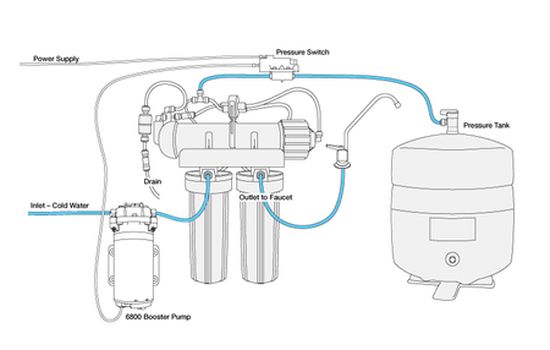
As refrigerators get more complex and offer features such as cold water dispensers, it is becoming more common to feed them with high quality water from an undersink reverse osmosis (RO) unit. The challenge in such hook-ups is how to provide sufficient water pressure for the refrigerator, especially since many of the newer refrigerators and ice machines require more feedwater pressure than older models.

With simple filters, just teeing into the undersink filter’s faucet tube works fine, since filters put out essentially the same pressure as the tap water source. With reverse osmosis units,  however, a standard system puts out only about 2/3 of the tap water pressure when the RO storage tank is full, and, of course, less as water is taken from the storage tank.

If city water pressure is strong–say, 60 psi or more–a standard reverse osmosis unit will usually rise to the occasion and supply plenty of water pressure for the refrigerator.  Important variables are distance between the RO unit and the refrigerator and the size of tubing used. Pressure loss is considerably less with 3/8″ tubing than with 1/4″, and shorter the distance between to the refrigerator the better.  With low city pressure or with well systems that have variable pressure, however, the RO unit may need some help.

Various devices are used to enhance pressure output of RO units when they send water to a remote point of use like a refrigerator. Here’s a look at the most common of these.
1. Booster Pumps.  The most commonly known of these are the popular Aquatec 6800 and 8800 booster pumps. These are electric pumps that increase the water pressure going into the RO unit. Increased inlet pressure, in addition to making the unit run more efficiently, increases the pressure coming out of the storage tank, but the out-of-tank pressure is limited to about 40 psi when the storage tank is full.  (There are tank switches that will run the pressure up to 60 psi, but we don’t recommend them for most residential users.)

2. Permeate Pumps.  These non-electric pumps do not increase inlet pressure but they isolate the RO unit from the back pressure from the storage tank, allowing it to run much more efficiently.  They can be installed with or without a hydraulic shutoff valve.  Without the shutoff valve they will put more pressure into the storage tank, but there are pros and cons to this type installation that should be considered.

The permeate pump runs on water pressure from the RO drain line and needs no electricity. In addition to sending higher pressure to the refrigerator, it improves the RO unit’s efficiency so that it uses less water.

3. Demand, or Deliver Pumps.  These electric pumps are installed after the RO unit and they push water directly from the output of the RO unit to the point of use–e. g., the refrigerator. They can deliver water with pressures up to 80 psi. They work on demand. When the icemaker calls for water, or if you activate the drinking water dispenser, the pump comes on and sends water to the refrigerator.


Pros and Cons
1. The booster pump is the best choice if your RO unit is starved for pressure.  If you have, let’s say, tap water pressure of 40 psi.  A standard RO unit will run on this pressure, but not well. What’s worse, it will put only 2/3 of that into the storage tank–25 psi or so even when the tank is “full”–so your refrigerator won’t get much water.  The booster pump will run the RO unit excellently and you’ll have a strong 40 psi of pressure in your full storage tank. Booster pumps are quiet and usually trouble-free.

2. With the same 40 psi inlet pressure, the permeate pump, if installed without the shutoff system (the pump itself will take over the shutoff function) will put almost 40 psi in the storage tank. It will also refill the tank much more quickly when water is taken from it. The permeate pump is trouble-free and needs no electricity. The model used with membranes that produce fewer than 50 gallons per day are very quiet. The over-50 gpd model makes a thumping noise that can be troublesome while the unit is producing water.

3. The demand pump will deliver 60 to 80 psi to the refrigerator regardless of the pressure in the tank (that is, unless the tank runs out of water, which can happen if the RO unit is a low producer).  The downside is that the pump won’t actually improve the performance of the RO unit as the other pumps do, but will simply increase the pressure to the refrigerator. Another issue is a phenomenon called “pump chatter.”  This doesn’t always happen, but if it does you won’t be able to ignore it. Pump chatter can be described as the pump turning on when no demand for water is made, running briefly–a couple of seconds usually–then turning back off.  This problem can be cured by installing a second RO tank between the pump and the refrigerator.  The tank provides the pump with constant back pressure which keeps it turned off.  It has the added advantage of giving you a couple more gallons of water, stored at maximum pressure and ready to supply the refrigerator.

As a final note, you can often improve flow to the refrigerator significantly by simply installing a second storage tank in the feed line near the refrigerator. This simple practice can improve pressure and the amount of water available to the refrigerator significantly.

More information you might like to look at:

How Permeate Pumps Work.

A Practical Guide to Water Treatment Pumps.

How Reverse Osmosis Booster Pumps Work.

How Small Demand or Delivery Pumps Work.

This article appeared originally in the Pure Water Occasional.

California water recycling facility reaches milestone

Modern Water Treatment Facility in El Segundo, CA

Water recycling is key for water companies in drought-stricken areas. Facilities that have been forward-looking enough in previous years to develop a water recycling process can now reap the benefits of having a reliable source of water to cover various municipal needs. The city of El Segundo, Calif., has already achieved this, as it was recently announced that its West Basin Municipal Water District (West Basin) has managed to recycle 150 billion gallons of water at its Edward C. Little Water Recycling Facility.

The milestone for the facility was reached in February this year. The total amount of water recycled is sufficient to meet the needs of 3.7 million people for a year, the West Basin Water District explained in a statement. In fact, the facility provides about 50 percent of the water used in El Segundo.

According to Donald Lear, vice president of the West Basin Board, the facility is one of a kind because it produces five different types of recycled water, with different properties and applications. Some of the recycled water is used for irrigation and is tertiary disinfected, while some of it is nitrified to be used as cooling tower water. The facility also recycles water to be used as low-pressure or high-pressure boiler feedwater, with the proper single pass or double reverse osmosis, and as indirect drinking water, which goes through microfiltration, reverse osmosis and UV light disinfection.

Source: Processing Magazine.

Pure Water Gazette Fair Use Statement

Arsenic in well water linked to lower IQ in children 

The presence of arsenic in drinking water may interfere with intellectual development in children, a new study by Columbia University and the University of New Hampshire has warned. Researchers spent five years testing and monitoring schoolchildren in Maine who were known to have been exposed to well water contaminated with arsenic. Results showed that arsenic could be linked to lower IQ in children, even if it was detected at levels as low as five parts per billion.

According to a state health official, about one in five private wells in Maine could have at least five parts per billion of arsenic in water. The effect of the chemical exposure could be compared to that of lead in the blood stream, said Joseph Graziano, professor at Columbia University. However, the research does not in fact conclude there is a cause-effect relation between the two and more research is needed to determine the mechanism in which arsenic exposure affects IQ test results, researchers said.

Children exposed to arsenic showed lower results in various sections of the tests, including Full Scale, Working Memory, Perceptual Reasoning and Verbal Comprehension scores, with their results averaging five to six points lower. Professor Amy Schwartz of the University of New Hampshire, test coordinator, commented that while the results point to a correlation between exposure to arsenic and lower intelligence, people should think of the research as informative, rather than as a cause for panic.

Article Source:  Water/Waste Processing

Pure Water Gazette Fair Use Statement

Ultraviolet 101 

by Gene Franks

Although ultraviolet light has several water treatment capabilities, such as reducing chlorine and chloramine, its main use by far is for microbe control.

Getting rid of microbial water contaminants can be done with chemicals, like chlorine or chloramines, by very tight filtration, as with ceramic filters, or by disabling the microbes with ultraviolet light. 

Ultraviolet, UV, is not new. As early as 1877, the germicidal properties of sunlight were known.

Landmark events in the development of modern UV treatment include the use of mercury lamps as an artificial germicidal light source (1901), the development of quartz as a UV transmitting medium (1906), and finally the development of the first genuine drinking water application of ultraviolet as a disinfectant in France in 1910.

The technology is, therefore, a century old, and it is used world wide. Nevertheless, it is still unknown to many US state and local regulating agencies, who continue to view chlorination as the only acceptable way to purify water.

UV treatment works not by “killing” bacteria, protozoa, and viruses, but by altering their DNA so that they cannot reproduce or infect. If chlorination is like chemical warfare directed at microbes, UV is more like a spaying and neutering program.

UV Light

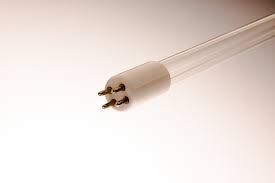
UV light in the 200 to 300 nanometer (nm) range is the most effective at treating bacteria and viruses. (Visible light falls in the 400-700 nm area.) For most practical UV applications in water treatment today, the light is generated by a mercury vapor lamp, or in a gas mixture that contains mercury. Mercury is the gas of choice because the light it puts out is in the germicidal wavelength range.

Lamp output depends on the concentration of mercury within the lamp, and the concentration depends on pressure. Low pressure lamps (called LP), the most common, produce UV light primarily at 253.7 nm, an ideal treatment wavelength. Some newer lamps are called “low pressure/high output” (LPHO) and some applications now use mixed vapor lamps called “amalgam” lamps. These require more electrical input and generate more UV output. LPHO lamps are roughly twice as powerful as LP, and amalgams may be about four times as powerful as LP.


UV Lamp

The Delivery System

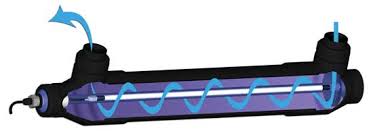
The standard way to treat unsafe water with UV is to send it though an elongated chamber where it is exposed to the intense light from the mercury lamp. UV bulbs are long and narrow to allow prolonged exposure as the water passes the length of the lamp.

The lamp itself is inside a transparent tube called the“quartz sleeve,” which protects it from contact with the water, and on the other side of the sleeve there is normally a metal reflective chamber. The water enters one end of the chamber, flows past the lamp to exit at the other end, and is in the process exposed for some time and at close proximity to the UV dosage put out by the lamp.


UV Dosage

UV dosage is typically measured in units called “Joules,” and it is most frequently expressed in terms of “mega Joules per square centimeter,” or mJ/cm². (Microwatts per second per square centimeter, expressed as µWs/cm2, and mJ/cm2 represent the same dosage and the two systems are used interchangeably.) The higher the number, the higher the dosage. 

The UV dosage received by the water increases as the flow rate of the water decreases, so a UV unit that puts out a dosage of 16 mJ/cm² while treating water at a flow rate of eleven gallons per minute (gpm) will be rated as 40 mJ/cm² if the flow rate is decreased to 4.5 gpm.

Put another way, a UV system rated by its manufacturer to treat water at 40 mJ/cm² at 4.5 gpm will be delivering a dosage of 16 mJ/cm² even if the user exceeds the recommended limit and runs the water at eleven gpm.

The tendency now in UV dosage is to follow the “more is better” view we’ve all been indoctrinated in. If ten nuclear bombs will destroy the world, to be safe we need ten thousand. The most common concerns, e Coli, Giardia, and Cryptosporidium, are effectively eliminated at less than seven mJ/cm². The minimum dosage now recommended by NSF, however, is 40 mJ/cm².

Factors That Affect UV Effectiveness

First, there is the age of the lamp. UV lamps lose strength with time, and almost all manufacturers assume a once-a-year replacement when they design their units. It is a mistake to believe that if the lamp is still burning all is well. UV lamps should be replaced once a year, and when replaced they should still be burning strong.

Then there is flow rate. The unit should be sized to provide adequate protection at the highest possible flow rates, but practicality should tell you that in most residential situations, most water is used at a couple of gallons per minute and a great deal of the time—most of the time, in fact—no water at all is being used.

Also a factor is general absorption of the UV light for unintended purposes. UV makers usually require that the water have less than seven grains per gallon of hardness, less that 0.3 ppm iron, less than 0.05 ppm manganese, and that it be generally clear and free of particulate and tannins. All of these can create situations where the light is absorbed and, therefore, its anti-microbial activity is diminished. Hardness, for example, can form scale on the outside of the quartz sleeve which blocks the passage of light.

A related factor is called shadowing. It is primarily caused by particles in the water which can allow microbes to “hide” from the light and not receive adequate UV dosage. The commonly accepted practice in UV treatment is to put a sediment filter of 5 microns or less in front of the treatment chamber to screen out any particles that could allow shadowing. Even if the water looks perfectly clear to the eye, putting a five-micron filter in front of the UV unit is a good idea.

UV as a Germicidal Treatment. Pros and Cons

The good thing about UV is that in addition to being a very effective treatment for microbes, it is relatively simple and inexpensive to buy and to maintain. It adds no chemicals to the water and leaves no “by-products.” It is very safe, if you follow a couple of simple rules (like don’t stare at a burning UV lamp because it can damage your eyes, and remember that treatment chambers can be hot to the touch). Compared to ozone, chlorine, or even hydrogen peroxide, UV is a very safe home treatment. Also compared with other treatments, UV requires little maintenance.

The main disadvantage of UV as germicidal treatment is that it has no residual effect. Bacteria are treated when they pass the lamp, but contamination that occurs downstream of the lamp is not treated. Chlorine and chloramine, by contrast, stay in the water from the point of treatment to the final point of use, preventing reinfection. The need for a constant supply of electricity can be seen as an additional disadvantage. If the power goes out, you shouldn’t use the water. Modern UV units often included devices to warn of power failure or even to shut off the flow of water if the power goes off.


UV from Pure Water Products

Classic Plastic Pura Units. We’ve been in business almost 30 years, and Pura was one of our first products. We started selling plastic-housing Pura UV systems just a couple of years after Pura went into business in the late 1980s, so it’s a product dear to our hearts. The Pura #20 lamp, used on all whole house plastic units, is, in fact, our most successful product in terms of sales. We stock all units and all parts, “every nut and bolt,” of plastic housing Pura units. We have an entire website, http://www.purauv.com, devoted to plastic-housing Pura units. We’re the best source, anywhere, for plastic Pura units and parts. We have some expertise with the units and can help with service issues.

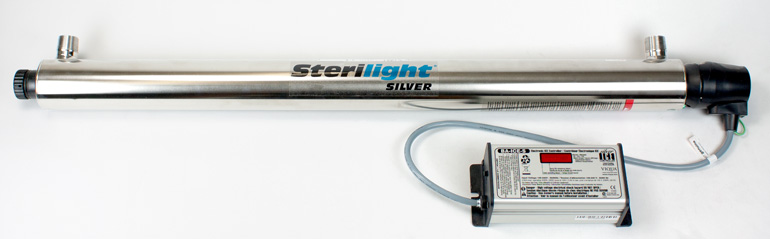
Stainless Steel Units. We have stainless units both by Sterilight and Trojan. We stock parts for both Watts and the now-discontinued Pura stainless steel units. Sterilight stainless units are now on our main website. We are factory-direct distributors for Sterilight and Trojan and can supply any replacement parts you need.


This article first appeared in the Pure Water Occasional for May 2011. The current version is updated and revised.

Waiting for water: Myanmar villages left behind

By Esther Htusan

DALA, Myanmar (AP) — Every afternoon, the long lines start to form, hundreds of men, women and children waiting to dip their plastic buckets into the lotus-filled reservoir just outside Myanmar’s biggest city, Yangon. It’s their only source of clean drinking water, they say, and during the dry season, April and May, there is only so much to go around.

“It wasn’t always this way,” says 72-year-old Tin Shwe, one of the village elders, as he looks at the queue, some boys as young as 8 waiting their turn, yokes at their side. “It used to be only paddy fields. Only a few houses. There was enough water for all of us.”

Myanmar only recently emerged from a half-century of military rule. Nascent democratic reforms implemented by the new civilian government since 2011 have resulted in a development boom, with the World Bank and others pouring billions of dollars into the country of 60 million as it starts to open up to the world. But so far, it is the big cities that are seeing the benefits.

Even places like Dala township — just a 20-minute boat ride from Yangon — have so far been left out. Authorities tell residents that maybe next year the government will start installing pipes so that water can be delivered straight to their homes.

The water shortages began with a population boom in the 1980s, with the number of inhabitants jumping from a few dozen to more than a thousand in part because they wanted to be close to the big city.

With no restrictions on how much water each family could take, the natural, fresh-water pond started running low. Eventually, just a decade ago, it dried up entirely. With no offers of help from the government, men like Tin Shwe decided to step in, devising a rationing system as water started seeping back so that residents could rely on it year-round.

Villagers have only one hour — between 4 p.m. to 5 p.m. — to get their water during dry season to limit its use. They are charged a tiny sum — 10 kyat for each bucket, or 10 U.S. cents. With so many takers it’s enough money for small upkeeps, like fixing the fence that surrounds the reservoir or stringing up electricity for lights.

People walk for up to five kilometers (three miles) with their empty buckets. They are allowed to fill up two each. If they need more, they can get back in line. When they are ready they begin the long, hard trek home.

“I usually get three buckets,” said 19-year-old Aye Thu Zar as she neared the front of the line. “There are seven in my family, so that’s enough for drinking and cooking. But the walk home hurts my shoulders. My legs, too. I can barely sleep at night the pain is so bad.”

She and others hope the new Myanmar will eventually reach Dala.

But for now, says Ko Ko, one of the villagers waiting his turn, “we are like water shortage refugees.”

Source: Seattle Pi.

Pure Water Gazette Fair Use Statement

Drink Water Early in the Morning 

Editor’s Note: There are bushels of articles telling you how much water to drink and what kind of water to drink, but not a lot like the one below that tells you when to drink.  In fact, according to the unnamed source of the article, early morning water drinking can cure most human ailments.  FYI: We don’t believe a word of it. 

It is accustomed in Japan to drink water after waking up early in the morning. Furthermore, scientific tests have proven its value. For many illnesses the water treatment had been found successful by a Japanese medical society as a 100% cure for the following diseases:

Headache, body ache, heart system, arthritis, fast heart beat, epilepsy, excess fatness, bronchitis asthma, TB , meningitis, kidney and urine diseases, vomiting, gastritis, diarrhea, piles, diabetes, constipation, all eye diseases, womb, cancer and menstrual disorders, ear nose and throat diseases.

METHOD OF TREATMENT

1. As you wake up in the morning before brushing teeth, drink 4 x 160 ml glasses of water

2. Brush and clean the mouth but do not eat or drink anything for 45 minute

3. After 45 minutes you may eat and drink as normal.

4. After 15 minutes of breakfast, lunch and dinner do not eat or drink anything for 2 hours

5. Those who are old or sick and are unable to drink 4 glasses of water at the beginning may commence by taking little water and gradually increase it to 4 glasses per day.

6. The above method of treatment will cure diseases of the sick and others can enjoy a healthy life.

The following list gives the number of days of treatment required to cure/control/reduce main diseases:

1. High Blood Pressure (30 days)

2. Gastric (10 days)

3. Diabetes (30 days)

4. Constipation (10 days)

5. Cancer (180 days)

6. TB (90 days)

7. Arthritis patients should follow the above treatment only for 3 days in the 1st week, and from 2nd week onwards – daily.

This treatment method has no side effects, however at the commencement of treatment you may have to urinate a few times. It is better if we continue this and make this procedure as a routine work in our life.

The Chinese and Japanese drink hot tea with their meals not cold water. Maybe it is time we adopt their drinking habit while eating!!!

For those who like to drink cold water, this article is applicable to you. It is nice to have a cup of cold drink after a meal. However, the cold water will solidify the oily stuff that you have just consumed. It will slow down the digestion.

Once this ‘sludge’ reacts with the acid, it will break down and be absorbed by the intestine faster than the solid food. It will line the intestine. Very soon, this will turn into fats and lead to cancer. It is best to drink hot soup or warm water after a meal.

Source:  News.Am

Over the years, the Gazette has published several dozen articles on the topic of water and health.  See them here.


Pure Water Gazette Fair Use Statement

Do coffee and tea really dehydrate us?

by Claudia Hammond

 Gazette’s Introductory Note:  Without a research grant or even giving the matter more than a couple of minutes thought I dismissed a long time ago the idea that the water that’s in coffee and tea somehow doesn’t “count” toward the body’s requirement for water.  If the human body can extract micro nutrients from foods why in heaven’s name would it not be able to find and use water that is mixed with a bit of tannins and caffeine?  Obviously, the water that’s in fresh fruit or a bowl of oatmeal is water that’s available for use by the body.  And as for coffee’s apparent diuretic properties, my view is that it’s mainly the water in the beverage that makes you pee a lot, not something special about the tea or coffee.  The research presented in the article below would seem to bear me out.–Hardly Waite.

Every day people around the globe drink 1.6 billion cups of coffee and around twice as many cups of tea.

They enjoy the taste and the fact that the caffeine wakes them up. But when we’re exhorted to drink six or eight glasses of water a day (a disputed figure that I’ve discussed previously), it’s usually emphasised that drinks like coffee and tea don’t count towards your daily liquid total because they’re dehydrating. Or so we’re told. What’s the evidence?

Although tea and coffee contain many different substances the one on which most research focuses is caffeine. Even then there is so little research on the topic, that one of the most frequently mentioned studies was conducted way back in 1928 with a sample of just three people. The three men were studied over the course of two winters. Sometimes they were required to drink four cups of coffee a day; sometimes they drank mainly tea and at other times they abstained or drank water laced with pure caffeine. Meanwhile the volume of their urine was measured regularly. The authors concluded that if the men consumed caffeine-laced water after a two month period of abstinence from both coffee and tea, the volume of their urine increased by 50%, but when they drank coffee regularly again they became inured to its diuretic effects.

Very large doses of caffeine are known to increase the blood flow to the kidneys and to inhibit the absorption of sodium which explains why it could act as a diuretic, dealing with the sodium which hasn’t been absorbed. But the exact mechanism is still a matter of debate.

But when you look at the studies of more realistic quantities of caffeine, the diuretic effect is not nearly so clear. A review of 10 studies by Lawrence Armstrong from the University of Connecticut concluded thatcaffeine is a mild diuretic at most, with 12 out of 15 comparisons showing that people urinated the same amount, regardless of whether the water they drank contained added caffeine or not.

So why do so many people think they need the loo more often when they’ve been drinking tea or coffee? As the review indicates, most studies give people pure caffeine added to water, rather than cups of actual tea or coffee as you might drink at home. Is there something about the combination of substances contained in coffee and tea that make the difference?

In a rare study where people drank nothing but tea for the 12 hour duration of the trial, there was no difference in hydration levels between them and the people who drank the same quantity of boiled water. When it comes to the consumption of coffee, one study did find a 41% increase in urine, along with a rise in the excretion of sodium and potassium. But these participants had abstained from caffeine before the study, so this doesn’t tell us what would happen in people who are accustomed to drinking coffee.

A second study found no difference in hydration between those drinking water or coffee, leaving us with conflicting findings. Then came new research earlier this year from Sophie Killer at Birmingham University in the UK, who not only measured the volume of urine, but tested their blood for signs of kidney function as well as calculating the total amount of water in the body. The men in the study drank four cups of coffee a day, far more than the average coffee-drinker. Yet there was no evidence they were any more dehydrated than those who drank water alone. This research was funded by the Institute for Scientific Information on Coffee, whose members are coffee companies, but it has been published in a peer-reviewed journal and the authors confirm that the Institute played no role in gathering or analysing the data or writing up the research.

So although we might notice needing the loo more when we’ve been drinking coffee, the mistake is basing our observations on a comparison with the time we’ve drunk nothing, not with a similar amount of water. If you chose a glass of water instead of a cup of tea, you’d probably see the same effect.

Source:  BBC.

Pure Water Gazette Fair Use Statement

Sebago water receives ultraviolet treatment 

by Ezra Silk

In response to Environmental Protection Agency regulations, the Portland  [OR] Water District is treating the water that it supplies to the Greater Portland area for cryptosporidium, a microscopic parasite that typically derives from animal waste and can cause severe gastrointestinal illness.

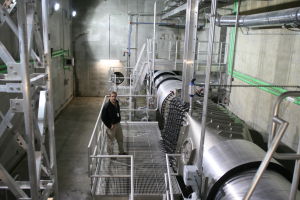
Beating a federally imposed deadline of April 1, the district has been operating two 14-foot, 84-lamp ultraviolet units for the past several months. The devices sterilize any cryptosporidium pathogens that may pass through, according to Joel Anderson, the chief operator of the Sebago Lake Water Treatment Facility.

“When UV attacks (pathogen) DNA, it actually breaks those cells and short-circuits them, and then renders them incapable of replicating,” said Anderson. “One cell in your system is not going to make you sick. When it gets into your system and begins to multiply is when you run into problems.”

According to Anderson, the district completed two years of monthly testing and never detected any cryptosporidium organisms in the water.

Joel Anderson, chief operator of the Sebago Lake Water Treatment Facility, said that one of the benefits of a new UV treatment system is that it does not add any new chemicals to the water supply. The average 21.5 million gallons of water that travel through the water treatment facility every day are treated with zinc orthophosphate, sodium hydroxide, sodium hypochlorite, aqua ammonia and hydroflourosilicic acid. 

“The good news is Portland Water District is of very low susceptibility to it,” Anderson said. “We don’t have a lot of farmland in our watershed. We have a natural filtration system that takes place at Sebago Lake.”

In 1993, a cryptosporidium outbreak in Milwaukee’s drinking water supply system made 400,000 people ill, and killed more than 100 people. In response, the Environmental Protection Agency began to draft the Long Term 2 Enhanced Surface Water Treatment Rule, which was adopted in 2006. The rule requires public water systems that use surface water to treat for cryptosporidium.

The average 21.5 million gallons of water that travel through the water treatment facility every day are treated with zinc orthophosphate, sodium hydroxide, sodium hypochlorite, aqua ammonia and hydroflourosilicic acid. Anderson said that one of the benefits of the UV treatment is that it does not add any other chemicals to the water supply.

“One of the reasons the Portland Water District chose to go with UV as opposed to a chemical process is because there are no known disinfection byproducts,” Anderson said. “It’s a physical process. People should not notice any taste. They should not notice any odor. It subjects it to a light. It’s a quick process.”

The facility’s ozone disinfection system, which kills viruses and giardia parasites, was also updated during the 17-month, $12 million project. The district received a $300,000 grant from Efficiency Maine to complete the project, and expects to save $150,000 on annual electric costs as a result of the upgrades. The program was primarily funded through the state Department of Health and Human Services’ Drinking Water State Revolving Fund.

According to the Centers for Disease Control, cryptosporidium can lead to stomach pain, dehydration, nausea, vomiting, fever and weight loss. It generally affects the small intestine, and can cause people with weak immune systems to succumb to chronic or fatal illnesses. Symptoms tend to set in two to 10 days after infection.

Michelle Clements, the water district’s spokeswoman, said that the improvements provide an additional safeguard to protect the quality of Greater Portland’s water supply.

“The project has added an additional barrier to potential contamination for our customers,” she said. “It’s just another way we provide safe, clean drinking water to our customers.”

Source: Lakes Region Weekly.

Water rates aimed at keeping precious commodity

by Gordon D. Fielder, Jr.


Editor’s Note: This piece explains a sensible approach to water pricing  that should be the practice of all water utilities: to charge more for increased water use rather than giving a discount to those who over-consume.  The article explains the rationale and the practice well. — Hardly Waite.


SALINA, Kan. (AP) — Salina’s water rates designed to help decrease consumption of a precious commodity

City water customers who are unsure if Salina is serious about conservation need only to become profligate with the garden hose this summer to clear up any doubts.

Salina abandoned its declining rate structure, which rewarded high use with lower cost, in favor of charging more for excess consumption.

“It used to be, the more you used the less it cost you,” said Martha Tasker, director of utilities. “In 2008 we changed that. Now we have a water conservation rate. Many would give it a much fouler name.”

The level of usage above which the conservation rate kicks in depends on a household’s base consumption.

Here’s how it works:

The city records a household’s winter quarter consumption rate — the amount of water used in January through March. That amount might be anywhere from 5,000 gallons a month to 10,000 gallons, depending on the size of household and personal water use.

The customer then is allowed to use 120 percent more than that each month before breaching the conservation threshold. This applies only to users who consume at least 6,000 gallons a month. The city spots all customers 6,000 gallons, so those who may use, say, 1,000 gallons, won’t reach the excess fee limit until they go over 6,000 gallons, not 1,200 gallons.

However, a household that averages 10,000 gallons a month during the three-month winter quarter would be able to use 12,000 gallons a month without paying the higher rate.

“Any water you use over that you pay an excess use rate for,” Tasker said.

For that first 12,000 gallons, the city charges $4.20 per 1,000 gallons. That comes to $50.40 a month, plus meter fees and taxes. Each 1,000 gallons over that, however, soaks the user for $8.40. So if the user instead consumes 13,000 gallons, that extra 1,000 gallons adds $8.40 to the bill, or $58.80.

The change attempts to encourage customers to be water misers.

“It doesn’t make sense if the more you use the less it costs. You’re not going to be very careful with how much you use,” she said.

The city draws its water from groundwater and from the Smoky Hill River. Tasker said river water costs less to treat, once it silts out, because it’s naturally soft. The water from the 15 wells is hard and must undergo treatment by chemicals, the cost of which keeps rising.

In winter, the city goes through about 5 million gallons a day, a rate that easily doubles in summer.

The conservation rate is intended to reduce the reliance on the more costly well water.

Water customers in Hutchinson and Manhattan pay less than Salina, in part because they still have a declining rate structure.

A 12,000-gallon monthly use in Hutchinson would cost $35.20 and in Manhattan, $37.29.

But an extra 1,000 gallons a month would bring the bill to $38.05 in Hutchinson and $46.17 in Manhattan.

Tasker said most Salinans shouldn’t expect conservation charges.

“Eighty to 85 percent never see excess use rates,” Tasker said.

In fact, many hover around the 6,000-gallon-a-month level.

“That’s 200 gallons a day,” she said.

To help customers with their water savings, the city has installed wireless metering that can track water usage by the hour. Before, water department employees had to eyeball each meter all over town.

“Nobody reads meters anymore,” Tasker said.

Small antennas in the meters bounce flow rates off a couple of water towers to city hall.

Leak detection software, once it’s fully up and running, can alert Tasker’s staff to unusual water use and who then can contact the homeowner.

For instance, the software might show water flowing 24 hours a day.

“That’s not normal,” Tasker said.

This will be especially useful for snowbirds who fly south for the winter.

“You could be gone and the water’s running into your basement and nobody would know (for a month),” she said.

“It’s about being accurate so people are paying for the actual water they are using,” she said.

Source: MySA.

Pure Water Gazette Fair Use Statement