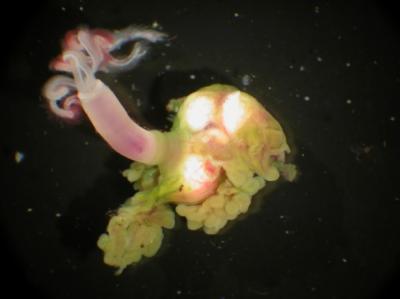
Osedax Live At the Bottom of the Ocean.  They Were Discovered On A Whale Carcass in 2002.

Among the ocean’s strangest inhabitants are some tiny worms that devour bones.  They inhabit and feed on dead whale skeletons and other bones on the sea floor.  It was recently discovered that they have a unique ability to release bone-melting acid which makes their lifestyle possible.

The worms are called Osedax, and like all worms in their family they get by without mouth, anus, or gut. The digestion of the bone they live on is made possible by their partnership with bacteria.  The worms are 3 to 4 cm long and they live in extremely hot and acidic vents in the sea.

These “bone-devouring worms,” whose official genus name is Osedax, are known to both eat and inhabit dead whale skeletons and other bones on the sea floor. They have a unique ability to release bone-melting acid

While it had been clear that the worms and their bacteria rely on nutrients such as collagen or fat from the bones they inhabit, until now it was a mystery how the worms penetrate the bone to access their nutrients. They appear to lack physical equipment necessary for drilling bone. The recently discovered process involves secretion of acid to demineralize the bone.

Researcher Sigrid Katz, perhaps the world’s foremost Osedax expert, says, “The discovery of Osedax shows that nutrition is even more diverse than we imagined, and our results are a step further in understanding the special relationship between the worm and its bacteria.”

Osedax are a female dominated society.  Males never grow beyond 1 mm.  In case you couldn’t tell, the worm in the picture is a female.

Adapted from Science Daily.

Rainwater Harvesting in Texas–A Practical Approach to Water Shortage

For centuries, people have relied on rainwater harvesting to supply water for household, landscape, livestock, and agricultural uses. Before the advent of large centralized water supply systems, rainwater was collected from roofs and stored on site in tanks known as cisterns. With the development of large, reliable water treatment and distribution systems and more affordable well drilling equipment, rain harvesting was all but forgotten, even though it offered a source of pure, soft, low-sodium water.

A renewed interest in this time-honored approach of collecting water has emerged in Texas and elsewhere because of escalating environmental and economic costs of providing water by centralized water systems or by well drilling. The health benefits of rainwater, and potential cost savings associated with rainwater collection systems have further spurred this interest.

An Outstanding Texas Application of Rainwater Harvesting


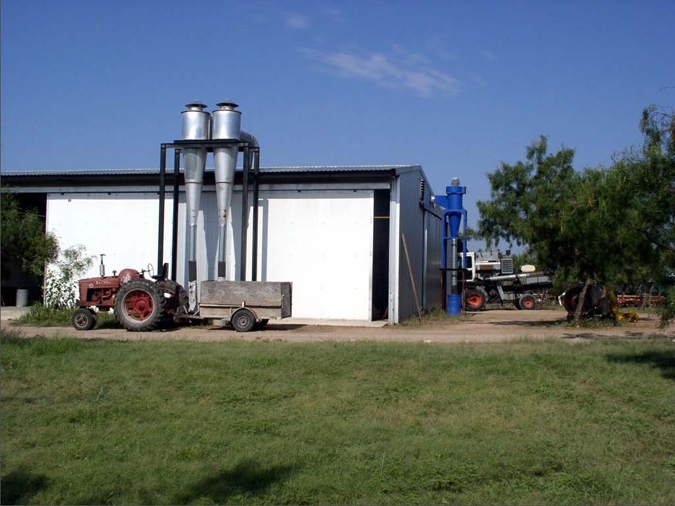
Native American Seed seed-cleaning plant, Junction, TX.

Native American Seed, founded in 1988 by Jan and Bill Neiman, specializes in native wildflower and prairie grass seeds from the Texas-Oklahoma-Louisiana region. In mid 2011, as the drought in the area took hold, the scarcity of drinking water became an issue and the Texas Commission on Environmental Quality began curtailing the watering of all native wildflower and prairie grass seed crop. Acting proactively, Native American Seed voluntarily cut back its farm production and – going a step farther – began to explore a more sustainable source of future water supply for its operations. They settled on rainwater harvesting.

The system that Native American Seed installed has a 30,000-gallon Pioneer Galaxy® tank, a 55-gallon first flush diverter, a 12V pump powered by a 185-watt solar panel, two sediment filters, one carbon filter, and an ultraviolet lamp. The pump and the treatment system are housed in a new pump house that was constructed of dry stacked cinder blocks with a plaster of surface bonding cement to insulate the pumping and filtration system in the pump house. The rainwater harvesting system is designed to meet up to 85% of the water demand (potable and non-potable) at the seed-cleaning plant.

Adapted from Texas Water Development Board News.

 In Its Naive Belief in Water Fluoridation The US Lags Pitifully Behind the Civilized World

by Hardly Waite

What do Austria, Belgium, the Czech Republic, Denmark, Estonia, Finland, France, Germany, Greece, Hungary, Iceland, Italy, Japan, Luxembourg, Mexico, the Netherlands, Norway, Portugal, Slovakia, Slovenia, Sweden, Switzerland,  and Turkey have in common?

They are among the world’s developed nations that do not fluoridate their drinking water. In fact, 97% of the advanced nations of western Europe do not fluoridate their drinking water.
Only 5 % of the world’s population drinks artificially fluoridated water.
There is no difference in tooth decay between western nations that fluoridate their water and those that do not.

At present, 97% of the western European population drinks non-fluoridated water. In most advanced countries, fluoridation has been tried and rejected.

In the United States, 64% of the population lives in areas where the public water supply is still fluoridated.

This is yet another area where the US is a backward country.  We still allow capital punishment, we still do research on animals,  and we still allow a systemic poison to be put in our water because of a slow-dying superstition that it prevents cavities in teeth.

Fluoridation of water has been around almost as long as blood-letting.  Isn’t it time we let it go the way of  medical treatment with leeches?


More about fluoridation.


 Amoeba Infection Is Usually From Sinus Irrigation with Tap Water

The amoeba Naegleria fowleri (N. fowleri), which has a 99 percent fatality rate, was found in water samples taken from the homes of two people from Louisiana who died in August 2012 from primary amebic meningoencephalitis (PAM) – an almost universally fatal infection – after using neti pots filled with tap water to irrigate their sinuses.

Neti Pot

Water samples taken from the victims’ homes tested positive for Naegleria fowleri (N. fowleri),  a climate-sensitive amoeba found in warm freshwater lakes and rivers.  N. fowleri has over a 99 percent fatality rate, with only one known survivor in the U.S. since 1962.

The amoeba enters the body through the nose and migrates through the olfactory nerve to the brain.  Symptoms, which occur one to seven days after exposure, include headache, fever, stiff neck, loss of appetite, vomiting, confusion, seizures, coma and death.

Here are some facts.

Although the condition is almost always fatal,  it is also very rare.  There are less than ten cases per yer in the US.  Some years there are none. The highest number of cases, 8, were reported in 1980.

The condition is not associated with general water use like drinking, bathing or showering.  It seems to be associated with water directly forced up the nose during sinus  irrigation.

N. fowleri is normally a warm-weather amoeba found primarily in Southern states, but it seems to be moving north,  probably because of climate change.

In most cases, city distribution systems do not test positive for N. fowleri,   but rather, the home’s plumbing.  How the amoeba enters the home’s piping system is unknown, but once in the pipes the organisms are able to survive and spread through the hot water system.

Read more.

Amebic meningoencephalitis due to Naegleria fowleri.

Federally Funded Wastewater Plant Will Run on 100-Percent Renewable Energy

AUSTIN (KXAN) – One of Austin’s wastewater treatment plants will soon be powered by 100-percent renewable energy. The Hornsby Bend Wastewater Treatment Plant in East Austin has a brand new 60,000-pound biogas generator. It will use methane gas created by the sewage treatment process at the plant to power the plant and more.

“This generator produces so much electricity that it runs the entire treatment process here at Hornsby Bend, and the water department will get a credit, because the generator produces more than it will actually need to use,” said Austin Energy spokesman Carlos Cordova.

Plant officials said the biogas generator will be able to produce 700 kilowatts of power. That is more than the 500 kilowatts needed to run the treatment plant. The leftover energy will be fed back into the power grid, and Austin Water will get a credit for it.

“According to Austin Energy estimates it’s about the equivalent of the power needed for 370 residential homes in Austin will be provided here with no outside fuel — all produced by methane gas,” said Orren West, plant division manager.

The new biogas generator has another green energy advantage. Austin Energy officials said the clean generation will reduce carbon dioxide emissions by 2,867 tons or the equivalent of taking away five million vehicle miles traveled in Austin.

The generator was paid for by federal stimulus money. It is currently being installed at the Hornsby Bend Wastewater Treatment Plant, and an Austin Energy spokesman said it should be up and running by the beginning of November 2012. The plant’s division manager calls it an exciting addition for the plant and for the taxpayers.

There’s more. The final product at the wastewater treatment plant is dillo dirt. It will be used as compost for gardening projects all over the city.

Read the original.

NSF Is the First Independent Laboratory Accepted to Evaluate Ballast Water Treatment Systems

NSF International (NSF), an independent public health organization, has become the first Independent Laboratory (IL) accepted by the United States Coast

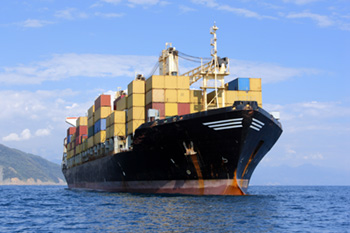
The Quality of Ballast Water in Ships Has Become An Increasingly Important Issue as Local Authorities Seek to Protect Their Waters from Invasive Species

Guard (USCG) to evaluate and test technologies designed to treat ballast water on ships in order to prevent the spread of non-native aquatic species in lakes, rivers and coastal waters.

NSF is widely known for developing standards and product testing for water treatment devices.  NSF International’s Water Programs require extensive product testing and unannounced audits of production facilities to verify that water treatment products meet the design, material and performance requirements. NSF International is accredited by the American National Standards Institute (ANSI).

Ballast water, while essential to the safe and efficient operation of modern shipping, can pose economic, ecological and public health risks when it carries non-native species around the world.  The USCG regulations were developed to limit the release of live organisms in ship ballast water to reduce the risks associated with the spread of aquatic invasive species.

Read NSF’s press release on the new ballast water project.

Yet Another of Water’s Weird Ways Remains to Be Explained

According to one scientist’s count, water exhibits  more than 80 unusual properties, one of the strangest of which is that it can  exist in all three states of matter (solid, liquid,gas) at the same time. Another example–it’s surface tension allows insects to walk on its surface and the property called “capillarity”   makes it possible for water to rise up from the roots into the leaves of trees and other plants.

In another strange turn, scientists have recently proposed that water can go from being one type of liquid into another in a so-called “liquid-liquid” phase transition.  It is impossible to test this with today’s laboratory equipment because these things happen so fast, but it has been tested by computer simulations.

Here’s Science Daily’s description of the experiment:

[The researchers] found that when they chilled liquid water in their simulation, its propensity to conduct heat decreases, as expected for an ordinary liquid. But, when they lowered the temperature to about 54 degrees below zero Fahrenheit, the liquid water started to conduct heat even better in the simulation. Their studies suggest that below this temperature, liquid water undergoes sharp but continuous structural changes whereas the local structure of liquid becomes extremely ordered — very much like ice. These structural changes in liquid water lead to increase of heat conduction at lower temperatures.

The researchers say that this surprising result supports the idea that water has a liquid-liquid phase transition.

Actually, water’s weirdness isn’t just a parlor game.  As Gene Franks wrote in “The Gazette’s Great Water Article,”

It is water’s perverse and consistent refusal to go along with science’s laws that makes our lives possible. The awesome fact that water expands when it freezes in a world where things are supposed to contract as they get colder allows life to flourish beneath the frozen surface of lakes and rivers: if ice sank, many bodies of water would never thaw. This is virtually a unique property of water, an entity that follows its own design and dances to its own tune.

See “The Gazette’s Great Water Article” for a lot more about water’s strange behavior.

Switching Either to Chloramine or Chlorine Draws Taste Complaints

One of the headaches of water treatment is that whenever there is change, there is complaint.
When cities switch from chlorine to chloramine disinfection, taste complaints are usually numerous and loud.
The irony is that when there is a temporary switch back to chlorine, which regulatory agencies recommend periodically, there are equally strong complaints about the taste of chlorine in the water.

When chloramine is used as the primary disinfectant,  the ammonia and nitrogen in chloramine can cause a biofilm buildup in pipes. A periodic, short-term change back to free chlorine, a much stronger disinfectant than chloramine, clears out some of the buidup. Cities often refer to the temporary change back to chlorine as “chlorine burns.”

Another item that affects taste is TDS, or Total Dissolved Solids, the mineral makeup of the water. That’s why when people become used to high TDS water (as in some bottled spring waters or some well water), they describe low TDS water, like reverse osmosis water or distilled water, as “tasteless.”  Reverse osmosis water drinkers, by contrast, are often shocked by the heavy mineral taste of tap water when they get a drink from a water fountain or restaurant.

With water, as with many things, people tend to like what they’re used to.  They may complain about the way things are, but when there’s a change,they complain twice as loudly.


Many Brands of Bottled Water Are Nothing More than Filtered City Tap Water.  So What?

by Hardly Waite

An article in the current Harold Sun of Sydney makes some fairly common complaints about bottled water.

The reader is warned in a headline:
TAKE a closer look at your bottle of “pure” water: it’s probably sourced from the tap. Millions of unsuspecting customers are buying filtered tap water and boiled rainwater at massive mark-ups of more than 180,000 per cent.

While the Pure Water Gazette has been a consistent critic of bottled water because of the environmental costs of draining aquifers, energy intensive transportation, and the creation of mountains of throw-away bottles, we feel that accusing bottlers of overcharging for an inferior product is unfair.

As long as the source of the water is clearly and honestly placed on the label, there is absolutely nothing wrong with purifying and reselling Waxahatchie TX tap water.  Fraud is one thing, but if the bottler is processing his water as described on the label (by carbon filtration, ozonation, reverse osmosis, for example), he is actually delivering a superior product regardless of its source.

These ladies bought bottled water largely for the convenience. Having the water in a bottle is wonderful. Have you ever tried taking water to the beach in your cupped hand?

Waxahatchie water that has been through a reverse osmosis system is better water–with disinfectants, fluoride, heavy metals and extraneous chemicals (if any) removed–than the water that comes from the tap.

Also, the seller isn’t just selling water.  He’s selling  convenience.  The consumer is actually paying the 180,000 percent markup to a large degree for the convenience of having the water in a bottle.  That’s no small thing.  A bottle, when you think about it, though the cost is low, is a marvelous convenience, one of the true wonders of the world.  Plastic bottles are an environmental disaster, but they are also wonderful from user’s perspective.

All water is recycled water.  There is nothing magic about “spring water” that makes it inherently superior to well-processed tap water.

If criticism is in order, it probably should go to consumers who buy the water, not to the businesses who sell it.

Bottled water is simply another example of the throw-away world we have created.  It’s fairly simple to resuse bottles and fill them with water from a home water purifier, thus reducing the markup by thousands of percentage points and making the environmental impact only a fraction larger than drinking straight tap water.  Anyone can do this.  Buying an expensive product when you could have something as good or better at a fraction of the cost doesn’t make the seller a crook, as the Harold Sun and other bottled water critics have implied, but it certainly does say something about the consumer.


More information from Sydney.

Vintage 1938 Cooling System at Disney Studio Is Blamed for Hexavalent Chromium in Area Waters

Walt Disney Studios in Burbank CA is being investigated as the possible source of groundwater contamination with the cancer causing heavy metal
Chromium 6.

Area groundwater has been contaminated for some time with Chromium 6, and aircraft manufacturer Lockheed Martin Corp. paid $60 million to settle claims with some 1,300 residents in 1996 who charged that exposure to Chromium 6 and other toxins at its former aircraft manufacturing plant left them with cancer and other maladies.

The suspicion is that an ancient cooling tower at Disney, built originally in 1938, is involved in the contamination of water in the area. The plant originally  used groundwater pumped from wells to pre-cool and pre-heat buildings on the site. At one point the plant circulated up to 1.7 million gallons of water a day. The wastewater was discharged into settling basins and then to the Los Angeles River as well as to Burbank’s storm system. In 1993, Disney replaced the system with cooling towers that relied on water supplied by the city of Burbank.

Chromium 6, also known as hexavalent chromium, has many industrial uses, including preventing corrosion of pipes in air conditioning systems and eliminating microbes in cooling towers.

Those who saw the 2000 film Erin Brockovich will remember hexavalent chromium, also known as Chromium 6, as the chemical spreading in a plume beneath the town of Hinkley, Calif., from a disposal site run by Pacific Gas & Electric.

Chromium 6 captured wide public attention in 2000 with the release of the Academy Award-winning movie Erin Brockovich about residents sickened by a Pacific Gas & Electric plant in the Mojave Desert city of Hinkley, CA. PG&E had used Chromium 6 as an anti-rusting agent to prevent corrosion in cooling towers, and has paid more than $600 million to settle lawsuits.

The Disney site has recently come under scrutiny by state and federal officials as part of a broader investigation into groundwater contamination. Citing community concerns about contamination, the California Department of Public Health in 2010 tested soil in a nearby park that historically had received discharges of water from Disney’s cooling system and found Chromium 6.

Disney denies that its cooling system is responsible for hexavalent chromium contamination in the area.

More information from the LA Times.

More about hexavalent chromium.