

How Much Water Is Too Much?

Over the  years much has been written about the proper amount of water for human consumption.  The rather silly “eight glasses per day” recommendation still gets repeated a lot, although no one really seems to follow the rule.  As Hardly Waite wrote, introducing an older Gazette piece on the subject:

The 8-glasses-per-day slogan has been mindlessly repeated for decades by physicians, nutritionists, diet gurus,  mothers, grannies, teachers,  and others who should know better.  Who knows where it originated.  You would think there was an Eleventh Commandment that says, “Thou shalt drink eight eight-ounce glasses of water per day.”

Does a slender woman who works in an air conditioned office and eats salads and fruits need the same 8-glass water ration as the beefy construction worker who spends the day in the sun and wolfs down potato chips and salami sandwiches?

Do both the secretary and the construction worker need the same amount of water on Tuesday and Friday?

The eight-glass rule has been implicated as a lead-in to serious water over-consumption problems.

A growing number of women are being diagnosed with water obsession, a little-known and researched condition that poses terrifying health risks. There have even been cases of people who have died from water intoxication, or hypnatremia,  to give it its proper medical name.

Water has come to symbolize well-being among many women, who, encouraged by the countless celebrities who espouse its health benefits of high water consumption, believe it will flush toxins from their system and improve their skin.

If 8 glasses is good, more is obviously better, and some women in Great Britain are now reported to be drinking up to 44 pints of water per day.  The practice can become a habit, and some have become closet drinkers, hiding their excessive consumption from their husbands and children.

Excessive water consumption is being recognized as a threat to the kidneys and to health in general because it can flush needed nutrients and minerals from the body.

For case studies of women suffering from hypnatremia, read more.

See also, How Much Water Do Your Really Need?
Shower filters make you sing better.

The Nation’s Waters Would Be in a Pitiful State Without It

This year marks the 40th Anniversary of the Clean Water Act,  the nation’s principal law to protect our waters.  To commemorate the passage of this landmark legislation, the Environmental Protection Agency (EPA) created a new page on its website called “Water Is Worth It“.


Here from the EPA’s website is a brief history of the Clean Water Act:

The Federal Water Pollution Control Act of 1948 was the first major U.S. law to address water pollution. Growing public awareness and concern for controlling water pollution led to sweeping amendments in 1972. As amended in 1972, the law became commonly known as the Clean Water Act (CWA).

The 1972 amendments:

  • Established the basic structure for regulating pollutants discharges into the waters of the United States.
  • Gave EPA the authority to implement pollution control programs such as setting wastewater standards for industry.
  • Maintained existing requirements to set water quality standards for all contaminants in surface waters.
  • Made it unlawful for any person to discharge any pollutant from a point source into navigable waters, unless a permit was obtained under its provisions.
  • Funded the construction of sewage treatment plants under the construction grants program.
  • Recognized the need for planning to address the critical problems posed by nonpoint source pollution.

Subsequent amendments modified some of the earlier CWA provisions. Revisions in 1981 streamlined the municipal construction grants process, improving the capabilities of treatment plants built under the program. Changes in 1987 phased out the construction grants program, replacing it with the State Water Pollution Control Revolving Fund, more commonly known as the Clean Water State Revolving Fund. This new funding strategy addressed water quality needs by building on EPA-state partnerships.

Over the years, many other laws have changed parts of the Clean Water Act. Title I of the Great Lakes Critical Programs Act of 1990, for example, put into place parts of the Great Lakes Water Quality Agreement of 1978, signed by the U.S. and Canada, where the two nations agreed to reduce certain toxic pollutants in the Great Lakes. That law required EPA to establish water quality criteria for the Great Lakes addressing 29 toxic pollutants with maximum levels that are safe for humans, wildlife, and aquatic life. It also required EPA to help the States implement the criteria on a specific schedule.


The EPA is a challenged entity.  Its effectiveness waxes and wanes according to the blowing in of the political winds, but it’s the best thing we have going.  The Gazette urges you to support the EPA, regardless of the direction of the hot winds blowing out of Washington.

The current mood in Congress has put the Environmental Protection Agency (EPA) in the crosshairs.  Several people in Congress and even one presidential candidate have stated that they would remove the power of the EPA to control pollution by doing away with the Clean Air and Water Acts; some would just get rid of the EPA altogether.
In North Texas we breathe some of the worst air in the country because our former US congressman stood up for our rights for years by opposing the EPA’s efforts to impose air quality regulations on us.  As you might guess, that former congressman doesn’t live here and breath the air.

Factory Farming For Fish


Posted September 11th, 2012

American Industry Turns Fish Into Water Polluters

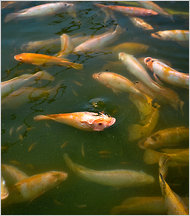
Fish are being grown in giant cages, nets, and ponds with the use of pesticides, hormones,  and antibiotics, all of which can result in significant water pollution.

Pollution also results from fish wastes and excessive food that goes into the water.  Escaping factory-farmed fish can also create dangerous genetic contamination.

Unfortunately, industrialized aquaculture facilities are replacing natural methods of fishing.

According to Food and Water Watch: 

Just as multinational corporations have forever changed the way food is grown on land to the detriment of public health, the environment, local communities and food quality itself, they are poised to do the same at sea. The identical factory-farm model is being adopted for aquaculture: growing food as cheaply as possible using toxic chemicals and other harmful techniques, packaging it in enormous bulk, and shipping it to distant grocery stores and restaurants all around the world.

Factory Farmed Talapia

Addressing An Urgent Need, The EPA Is Providing Training and Assistance to the Nation’s Many Small Water Systems

More than 97 percent of the nation’s 157,000 public water systems serve fewer than 10,000 people, and more than 80 percent of these systems serve fewer than 500 people.

This is an often ignored fact. It is also overlooked that most of the regulatory energy of governmental agencies is directed toward the large treatment systems that serve metropolitan centers.  EPA standards do not apply to the many small systems that fall under the regulatory radar.

Many small systems face unique challenges in providing reliable drinking water and wastewater services that meet federal and state regulations. These challenges can include a lack of financial resources, aging infrastructure, management limitations and high staff turnover.

The U.S. Environmental Protection Agency has awarded nearly $15 million in funding to provide training and technical assistance to small drinking and wastewater systems – those serving fewer than 10,000 people – and to private well owners. The funding will help provide training and tools to improve small system operations and management practices, promoting sustainability and supporting EPA’s mission to protect public health and the environment.

“Small systems form the backbone of our nation’s public water system and it is a priority for EPA to help them to meet water quality standards and provide clean water to communities,” said Nancy Stoner, EPA Acting Assistant Administrator for Water. “This funding and technical assistance is part of EPA’s continuing efforts to promote sustainability and public health protection for communities served by small systems.”

For more information on EPA’s programs and tools to help small water systems, visit:http://water.epa.gov/grants_funding/sdwa/smallsystemsrfa.cfm

Full text of the EPA press release.

New Zealand Joins Ecuador in Granting Rights to A Body of Water

Introductory Note: In “The Gazette’s Great Water Article,”  Gene Franks wrote: “The degradation of water in modern America has been cruel and complete. Water has meaning only to the extent that it is useful to us. We speak of animal rights and children’s rights, meaning the rights of animals and children, but “water rights” refers only to the right of humans to exploit water. Water itself has no rights, no existence apart from our purposes.”  It is encouraging that at least two countries, New Zealand and Ecuador, have seen fit to officially recognize the legal rights of water.–Hardly Waite, Gazette Senior Editor.

From the dawn of history, and in cultures throughout the world, humans have been prone to imbue Earth’s life-giving rivers with qualities of life itself — a fitting tribute, no doubt, to the wellsprings upon which our past (and present) civilizations so heavily rely. But while modern thought has come to regard these essential waterways more clinically over the centuries, that might all be changing once again.

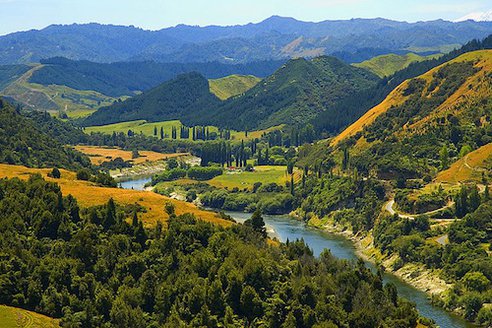
Meet the Whanganui. You might call it a river, but in the eyes of the law, it has the standings of a person.

New Zealand’s Third Largest River, the Whanganui, Has Been Granted the Rights of “Personhood”

In a landmark case for the Rights of Nature, officials in New Zealand recently granted the Whanganui, the nation’s third-longest river, with legal personhood “in the same way a company is, which will give it rights and interests”. The decision follows a long court battle for the river’s personhood initiated by the Whanganui River iwi, an indigenous community with strong cultural ties to the waterway.

Under the settlement, the river is regarded as a protected entity, under an arrangement in which representatives from both the iwi and the national government will serve as legal custodians towards the Whanganui’s best interests.

“Today’s agreement which recognises the status of the river as Te Awa Tupua (an integrated, living whole) and the inextricable relationship of iwi with the river is a major step towards the resolution of the historical grievances of Whanganui iwi and is important nationally,” says New Zealand’s Minister for Treaty for Waitangi Negotiations, Christopher Finlayson. (more…)

After 20 Years of Drilling, Russian Scientists Breached  Lake Vostok in  the Antarctic

It is the first time one of Antarctica’s subglacial lakes was penetrated.

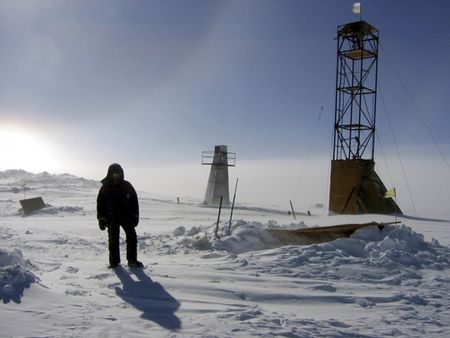
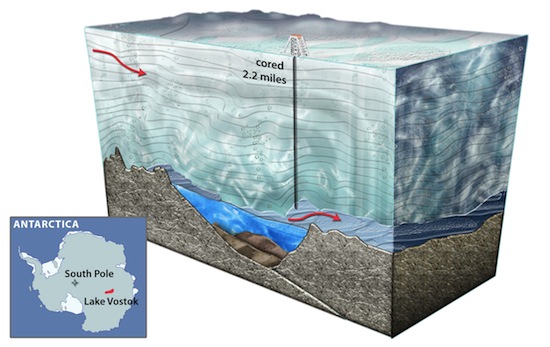
On February 5,  2012, Russian scientists confirmed that they successfully drilled into Lake Vostok, a subglacial lake that has spent the last several million years isolated from Earth’s surface by a thick slab of ice. And it really is thick! — drilling down to the lake has taken 20 years of work. But the team has finally hit water, and the water could contain clues to (among other things) the mechanics of climate change.

It’s possible the lake contains new life forms, maybe bacteria. It’s also possible — and the initial samples seem to support this hypothesis — that it’s totally sterile, the only place on Earth with water but no life. Both options have the potential to help scientists understand more about life on Earth, and how it does or doesn’t survive in extreme conditions.

The untouched water in the lake will also allow researchers to compare ancient and current water, looking for changes that might help illuminate global warming and sea level rise.

Antarctica holds 70% of the planet’s fresh water as ice and subglacial liquid.  Understanding whether and how it is changing is key to understanding possible future rises in global sea levels.

Lake Vostok has been isolated from the surface for millions of years, and many hope it contains bizarre new life forms.  At present, however, that seems unlikely. The drillers have already sampled wedges of accretion ice – lake water that has naturally frozen onto the underside of the ice sheet – and although some researchers claim it contains bacteria, others write this off as contamination.

If Lake Vostok turns out to be sterile, that will make it the only place on Earth where there is water but no life.

For more information on the Lake Vostok project, see  Mysteries of Lake Vostok on brink of discovery.”

Russian scientists breached Lake Vostok in the Antarctic .


Almost Half of the Nation’s Land Area Is In Various Stages of Drought

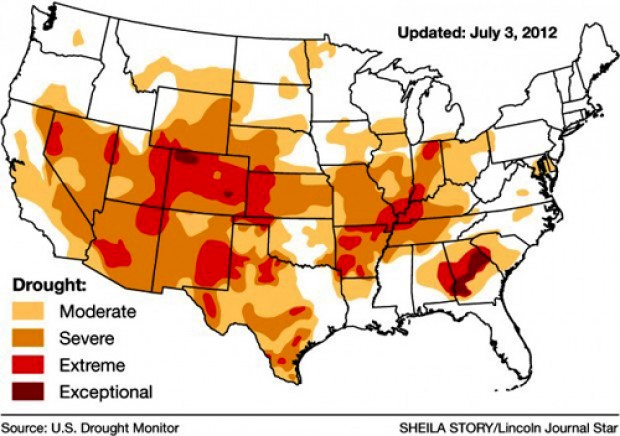
The National Drought Mitigation Center at the University of Nebraska-Lincoln has been monitoring droughts for a dozen years and it says that the current dry spell afflicts more of the nation than ever before.

Analysis of the latest drought monitor data revealed that 46.84 percent of the nation’s land area is in various stages of drought.

The previous record was 45.87 percent in drought set Aug. 26, 2003.

The map below (from the National Drought Mitigation Center) shows the situation as of Independence Day, 2012.

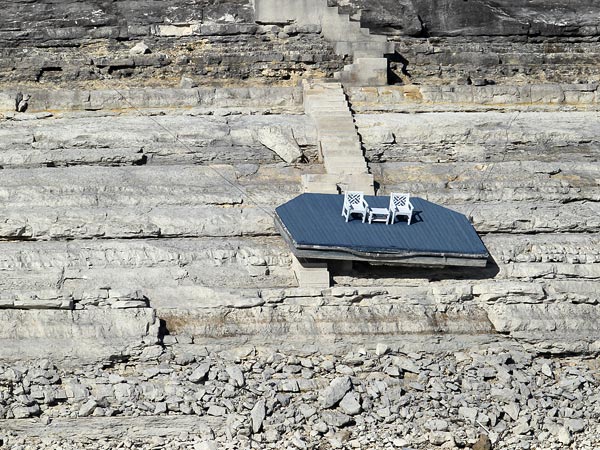
Across much of the western United States,  extremely dry  conditions have caused cities, farms, and businesses to fear for the future of their water supply as demand outstrips availability.The striking picture below tells it all.

A once-floating dock was left high and dry by drought conditions that lowered the level of Medina Lake some 52 feet (16 meters). The lake, which provides water to Texas farmers and the city of San Antonio, is shrunken thanks to an ongoing drought that includes the driest, hottest 12 months in Texas’ recorded history

 See more striking drought pictures in National Geographic’s special drought feature.


More about the drought

For Academic Success You Just Have To Carry Water.  You Don’t Have to Actually Drink It.

by Hardly Waite

A  study presented at a psychology conference in London in April of 2012 suggests that students who bring water to drink while they  take exams may improve their grades.   This is, it is assumed, because they keep themselves hydrated.

The simple act of bringing water to the exam was linked to improvement in grades, although hypotheses put forth by the researchers indicated that they had not the slightest notion why. It was suggested that having water reduced anxiety.  The researchers did not examine whether the students actually drank the water,  so this does not rule out the possibility that the influence may have come wholly or partly from just having the bottle there.  Nor does it rule out the possibility that it was all simply coincidental that students who happened to take water into the exam scored higher and that neither the bottle nor the water had anything to do with the matter.

In all, 477 students took the exam. One important observation was that students in the higher grade levels were more likely to take water to exam sessions than students in earlier years.

The Medical News Today report on the research concludes:

[The chief researcher] said more research would be needed to tease apart these factors and their underlying explanations.  But whatever the result, he suggests it is probably a good thing for students to try and keep themselves hydrated while sitting exams. Judging from the results of this study, it appears that first year undergraduates in particular need to hear this message. There is an implication here for education policymakers too: whether students, at all levels of education, should have access to drinks during exams.

The Pure Water Gazette concludes:  A university psychologist  was desperately trying to put an academic publication on his record and all the good subjects, like the influence of  pencil color on penmanship, had already been exhausted.

For complete details of this important research, see Medical News Today.


Texas Capital Takes Water Conservation Seriously as Drought Lingers On

The severity of the drought in Texas was underlined in early Sept. by the shutdown of such familiar water features as downtown Austin fountains. This was mandated as the city of Austin issued a Stage 2 drought declaration.

The declaration was put in effect when the two main lakes, Lake Travis and Lake Buchanan, reached the 900,000 acre-foot trigger mandated by the city’s Drought Contingency Plan.

Here are some of the restrictions that went into place with the Stage 2 declaration.

  • Hose-end irrigation may take place between midnight and 10 a.m. and between 7 p.m. and midnight on your assigned watering day.
  • Automatic irrigation systems may operate between midnight and 5 a.m. and between 7 p.m. and midnight on your assigned watering day.
    • Please reduce system run times to fit within this schedule.
    • Please ensure that your system has a working rain sensor, or operate the system manually when rain is forecasted.
  • Watering with a hand-held hose or bucket is allowed at any time on any day of the week.
  • Drip irrigation is exempt from the schedule, due to increased efficiency.
  • To water trees, soaker hoses may be used under the drip-line of the tree canopy or you may use your automatic tree bubblers.  Irrigating trees in this manner is exempt from the watering schedule
  • Washing vehicles at home is prohibited. If you need to wash a vehicle, you may do so at a commercial carwash facility.
  • Charity car washes are prohibited
  • Fountains with either a fall or spray of water greater than four inches are prohibited; unless necessary to preserve aquatic life.
  • Restaurants may not serve water unless requested by a customer
  • Commercial properties (including restaurants and bars) may only operate patio misters between 4 p.m. and midnight.

Learn How to Care for a Tree During Drought at Austin Water’s Website.

What is ground water?

When water falls as rain or snow, much of it either flows into rivers or is used to provide moisture to plants and crops. What is left over trickles down to the layers of rock that sit beneath the soil.

And just like a giant sponge, this ground water is held in the spaces between the rocks and in the tiny inter-connected spaces between individual grains in a rock like sandstone.

These bodies of wet rock are referred to as aquifers. Ground water does not sit still in the aquifer but is pushed and pulled by gravity and the weight of water above it.

The movement of the water through the aquifer removes many impurities and it is often cleaner than water on the surface.

Africa Has Vast Hidden Water Resources, But They Must Be Used Wisely

There is enough water for human need,  not human greed.” ~Mahatma Gandhi

Africa is a notoriously dry continent, but things may not be as bleak as one would suspect as climate change advances.

Currently, the situation appears bad.  At present only about 5% of arable land is irrigated.  Across Africa more than 300 million people are said not to have access to safe drinking water. Water for sanitation is in short supply.  Demand for water is set to grow markedly in coming decades due to population growth and the need for irrigation to grow crops.

Yet,  a BBC report says that Africa is sitting on a vast reservoir of groundwater–with pools suspected to contain 100 times the amount to be found on the surface.

Researchers have for the first time been able to carry out a continent-wide analysis of the water that is hidden under the surface in aquifers. Researchers from the British Geological Survey and University College London (UCL) have mapped in detail the amount and potential yield of this groundwater resource across the African continent.

The researchers say their new maps indicate that many countries currently designated as “water scarce” have substantial groundwater reserves.

The new mapping that shows formerly unsuspected ground water resources leads to cautious optimism. Caution is necessary because although there are vast groundwater reserves, experts believe that rapid extraction through large boreholes might not work in the region and that moderation in harvesting groundwater may be necessary.  The lead author of the study told the BBC: “High-yielding boreholes should not be developed without a thorough understanding of the local groundwater conditions. Appropriately sited and developed boreholes for low yielding rural water supply and hand pumps are likely to be successful.”

Water was added to the aquifers over 5000 years ago.  It must be harvested respectfully.

BBC Report for More Details