




The Take-Our-Word-For-It Water News for June 2026
From this point our Water News in the Occasional will provide only an occasional source link. Please use a search engine to find information if you want to pursue the topic.
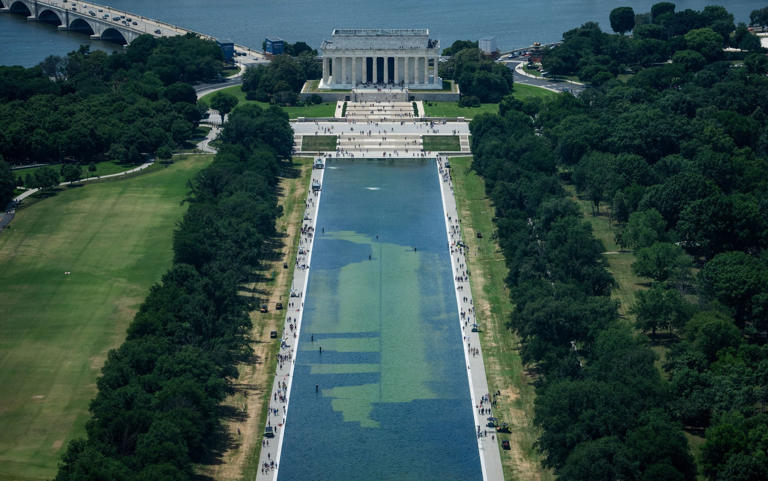
Trump’s Infamous Pool Fiasco
June’s most persistent water story was the embarrassing algae takeover and alleged “vandalism” of the “blue” pool at the Lincoln Center. The president paid millions for a no-bid pool repair deal that that turned out badly.
Drought Paradox
A study reported in LiveScience reveals that plants around the Colorado River turn to groundwater when it gets too hot and dry, reducing flow into the already strained basin. Vegetation draws on groundwater during dry summers, leaving less water for the river and, ultimately, people. (The Gazette’s take on this is that plants aren’t as dumb as some people think. They take any water they can get and let food crops in California fend for themselves.)
EPA Settled PFAS Claims with Chemours
The EPA got over $450 million in penalties and relief in an agreement with the chemical company Chemours to settle claims over PFAS pollution in three states. EPA alleges that Chemours released PFAS into the Cape Fear River (North Carolina), the Delaware River (New Jersey), and the Ohio River (West Virginia) — in some cases without required permits, and in other cases in violation of those permits.
US Targets Reservoirs
A US attack on two water reservoirs in the Bemani area of Sirik in southern Iran, located on the shores of the strait of Hormuz, left 20,000 people without drinking water, according to an Iranian water utility company. Hormozgan province water and wastewater company, or Abfa Hormozgan, said the reservoirs were “targeted and completely destroyed” by US military fire. Targeting civilian water reservoirs is a clear violation of standard rules of warfare followed by most of the civilized world.
EPA vs. Wego Chemical Group
U.S. Environmental Protection Agency filed an “administrative complaint”
According to The Guardian, Data Centers Are Water Hogs and It’s Going to Get Worse
Scientists have determined that the climate crisis, caused by the burning of fossil fuels, is worsening the duration and intensity of droughts in the US.
But a stampede of new data centers are adding extra demands via their hefty energy and water requirements. Large datacenters, some the size of small towns, can require up to 5m gallons of water a day, equivalent to the water use of up to 50,000 people, in order to provide cooling to arrays of humming networked computers.
Overall, the multiplying datacenters across the US are set to demand as much as 73bn gallons of water a year by 2028, up from about 17bn gallons in 2023. Each 100-word AI prompt uses up roughly one 500ml bottle of water due to the cooling needs of datacenters, researchers have estimated.
“The AI industry is sprinting as fast as it can to gain market dominance, and the rest of us have to deal with a great increase in water demand in places already in drought,” said Christopher Dalbom, an expert in water resources law at Tulane University.
“Even if there wasn’t climate change, we’d be feeling the effects of droughts more acutely, because water demand is going up and up, to feed more people and water more lawns and crops. There isn’t enough water to go around. Now with this explosion of datacenters, I think a crunch point is inevitable.”
Companies such as Google, Meta, Microsoft and Amazon are pouring billions of dollars into new datacenters, with developers often drawn to dry, sparsely populated areas, due to the lower cost of land and generous tax breaks. Arid climates are also thought to cause the least amount of corrosion to equipment over time.
One of the world’s largest datacenters, a complex twice the size of Manhattan, was last month controversially approved in a Utah county that has been deep in drought since summer last year. Meanwhile, Walla Walla county in Washington, site of a planned Amazon datacenter, has also been overwhelmingly in drought since July last year.
In Texas, two of the largest new datacenters are arriving in counties – Pecos county and Carson county – recently parched by drought. Datacenters could account for 9% of Texas’s total water use by 2040, researchers recently calculated, with the state’s water development board forecasting Texas will have to deal with rising overall demand and falling supply of water in the decades ahead.
The UN warns that ‘Severe’ stress on oceans as rate of sea level rise doubles in 10 years
The world’s oceans are under “severe and accelerating” pressure from human activities, with the rate of sea-level rise double that of a decade ago, according to a damning assessment from the United Nations.
The “intensifying” stressors, which include pollution and large-scale industrial fishing, are cumulative, resulting in widespread biodiversity loss and putting ocean systems under “severe strain”.
The UN’s third World Ocean Assessment, which reflects the work of nearly 600 scientists from 86 countries, looked at the oceans’ health from 2021-25. The previous report, that covered up to 2018, found persistent degradation of the marine environment.
Five years on, scientists know more about the cumulative impacts of anthropogenic pressures on the ocean, and the latest report shows just how much of the damage has been done in the past few years. The scientists’ key findings include:
Sea levels continue to rise at an increasing rate, from 2mm a year prior to 2015 to 4.3mm a year in 2023.
16% of the increase in global ocean heat since 1955 occurred after 2018.
The greatest relative warming has been observed in the Atlantic Ocean and the southern parts of the Indian and Pacific Oceans.
Large gaps in knowledge persist – with only 27% of the ocean floor mapped by 2025, deep-sea ecosystems remain poorly understood.
Has All Water On Earth Been Peed at Least Once?
A LiveScience study says probably not.
On the water side of the equation, the U.S. Geological Survey estimates that Earth has about 1.4 billion gigatons of water, including that in oceans, ice caps, glaciers, lakes, rivers, groundwater and vapor.
If you divide the weight of the world’s water by 0.2 gigatonnes of pee each day, it would take around 7 billion days, or about 19 million years, “to pee out the whole ocean,” one expert said. Given that the asteroid that “smacked the Yucatan” and wiped out the nonavian dinosaurs struck 66 million years ago, “even mammals have probably peed more than an ocean since we took over,” he said.
David Kreamer, a professor of hydrology at the University of Nevada, Las Vegas, agreed that when “you go back in history to the dinosaurs and things like that, that’s a lot of pee.” But he also said calculations that depend on assumptions and generalizations have a large margin of error.
Instead, when it comes to whether every last drop of water on Earth has been peed at one time or another, Kreamer said the answer is no.
Paraquat and Parkinson’s Disease
Though it is banned in many nations, the herbicide Paraquat is widely used in US agriculture. Paraquat is a valued killer of many weeds, but it is also linked to the vast increase in Parkinson’s cases. Paraquat is effectively removed from drinking water with carbon block filtration and reverse osmosis, but the real concern is the rise in Parkinson’s among farm workers. Parkinson’s is the fastest growing neurological disorder in the world.
Col0rado Governor Declared a Dire Drought Emergency
Colorado Governor Jared Polis declared a statewide drought emergency on June 4, 2026, activating the highest tier of the state’s drought response plan after a record-warm winter left snowpack near its lowest level in nearly four decades. Days earlier, federal forecasters delivered an even starker warning downstream: Lake Powell could fall below 3,490 feet — its “minimum power pool” — as early as August 2026, the elevation at which Glen Canyon Dam can no longer reliably generate electricity. Together, the two developments mark the moment the West’s slow-motion water crisis stopped being a forecast and became an emergency on the ground.
This is a distinct escalation from the basin-wide Colorado River shortage and Arizona’s delivery cuts WaterVerge covered earlier this spring, and it goes beyond the Front Range drought restrictions already in place around Denver, Erie, and Aurora. Colorado’s formal statewide declaration, and the accelerated timeline on Lake Powell’s hydro power threshold, are both new — and both raise the stakes for the roughly 40 million people who depend on the Colorado River.
A global report reveals the link between unsafe water and hunger
A landmark study spanning 121 countries has found that people without access to clean drinking water are pointedly more likely to go hungry, a link that holds even in wealthy nations and demands a fundamental rethink of how the world tackles food and water policy.
The connection between unsafe water and hunger may seem intuitive, yet for decades policymakers and humanitarian organizations have treated them as separate problems, solved by separate ministries, funded through separate budgets, and measured by separate metrics. A major new study published in Nature Food challenges that siloed approach with some of the most comprehensive global evidence yet assembled.

