


Water News for August 2026

Plan for Colorado River Water Crisis Finally Unveiled by US Government
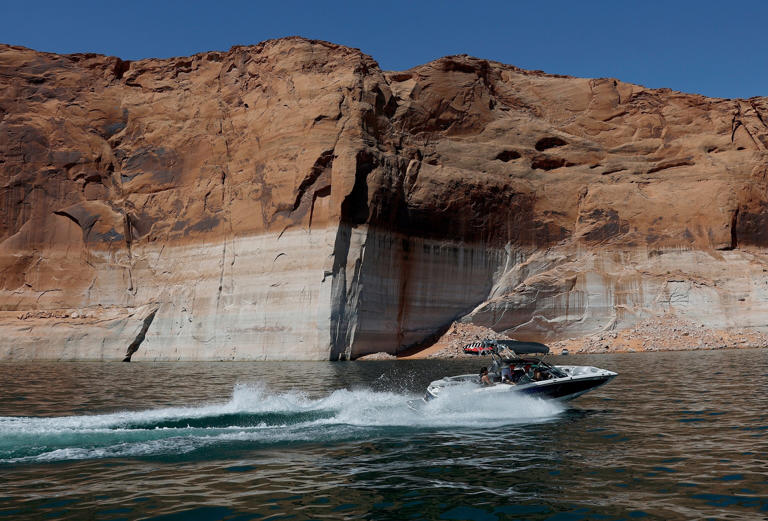
Bathtub Ring on the Stone Wall Grows Larger on Lake Powell
The US government released its anxiously awaited plan for how to manage the Colorado River crisis on July 31, which includes the potential for harsh cuts in water supplied to California, Arizona and Nevada.Under the proposal, the so-called lower basin states stand to lose up to 3m acre-feet (3.7bn kiloliters) a year – enough water annually to serve more than 25 million people and roughly 40% of their collective total. The so-called upper basin states – Colorado, Utah, New Mexico and Wyoming – were spared from mandates restricting their supply. The Colorado River supplies roughly 40 million people in seven states, two countries and dozens of tribes, and also irrigates 5.5m acres (2.2 hectares) of farmland. The federal government has limited jurisdiction over state-based water policy but is responsible for managing the dams at Lake Powell and Lake Mead, the two key reservoirs that lower basin supplies flow through. (The Guardian)
Lake Mead, the largest reservoir in the United States, has fallen to a record low — yet another sign that the Colorado River system is spiraling further into crisis.
Water levels in Lake Mead dropped to 1,040.5 feet, below the previous record low of 1,040.58 feet set in July 2022, according to data published by the US Bureau of Reclamation. The lake is now lower than it’s ever been since it was created nine decades ago. (CNN)
Border Wall Construction Is Robbing Water From Ranchers
Construction crews building a border wall in New Mexico were ordered to stop drilling new wells after ranchers said that pumping groundwater to produce concrete could threaten their livestock amid a severe drought. (The Guardian.)
Cyber Attacks on Water and Wastewater Facilities
On July 30, the Environmental Protection Agency (EPA) and Federal Bureau of Intelligence (FBI) released a joint statement warning about cyberattacks on water utilities across the country. So far, there have been 12 cyberattacks reported across the country that have targeted water and wastewater treatment facilities.
“After remotely accessing internet-facing devices, the actors changed the IP addresses and passwords, resulting in a loss of monitoring and control functionality,” the FBI reported.
Reports suggest that Iran is the prime suspect in these attacks, but there is no confirmed involvement to date. The FBI is also urging utilities to protect themselves by taking actions like disconnecting systems from the internet when possible and familiarizing operators with manual controls in the case of compromised automated systems.
The agencies also reaffirmed the necessity of complex passwords for security and proper firewall configurations to prevent unauthorized devices from connecting to internal systems. (WC&P)
Record Rainfall in China
More than a million people had to be evacuated in China because of record rainfall resulting from Typhoon Dolphin. (The Guardian)
The EPA Finally Enters the Fluoride Debate
The following is from an EPA press release: “Today, U.S. Environmental Protection Agency (EPA) announced the next step in its review of public health risks linked to fluoride in drinking water: the release of the Protocol for Developing the Fluoride Human Health Toxicity Assessment. This marks a significant milestone in the agency’s expedited assessment of fluoride under the Safe Drinking Water Act (SDWA), a priority set by EPA Administrator Lee Zeldin as part of the Trump Administration’s commitment to Make America Healthy Again, while following gold standard science.
“Every American should be able to count on safe and healthy drinking water, plain and simple. In light of new science and real concerns from the public, the Trump EPA is working in lockstep with HHS to expedite our review of fluoride under the Safe Drinking Water Act,” said EPA Administrator Lee Zeldin. “Today’s important milestone means we are another step closer to completing this assessment years ahead of schedule. Our new action outlines specifically how EPA’s assessment will be conducted and advances our commitment to transparency and gold standard science.”
“Parents deserve the truth about fluoride in drinking water—not assumptions, not politics, but rigorous science,” said U.S. Department of Health and Human Services Secretary Robert F. Kennedy, Jr. “That is why HHS is working side by side with EPA to ensure this assessment focuses on the health risks that matter most for children, including neurodevelopmental effects and dental fluorosis. By conducting a rigorous dose-response analysis and making every step of the process transparent, we will give states, communities, and families the scientific foundation they need to make informed decisions about fluoride in drinking water.”
Earlier this year, EPA released its Preliminary Assessment Plan and Literature Survey for public comment. The agency’s new Protocol for Developing the Fluoride Human Health Toxicity Assessment reflects public input received on that plan. The Protocol is an essential part of developing the human health assessment; it is a road map that transparently describes how EPA will conduct the assessment while applying gold standard science.
EPA’s assessment of fluoride under the SDWA will consider neurodevelopmental effects in children (e.g., negative effects on brain function, including lower IQ). EPA’s assessment will also consider the negative health effects of dental fluorosis (e.g., discoloration and pitting of tooth enamel) in children. The agency will develop a human health toxicity assessment examining how much exposure to fluoride causes these negative health effects. This is called dose-response analysis, which EPA uses to determine the fluoride levels that a person can be exposed to without experiencing harmful health effects. The Protocol explains the scientific plan for conducting this analysis.”
The agency will use this Protocol to develop the draft fluoride human health toxicity assessment, which once completed will be available for public comment. EPA will use systematic review practices that are consistent with gold standard science and SDWA requirements, draw on expertise from the U.S. Department of Health and Human Services (HHS), and will not prejudge any outcomes of the assessment. When final, the assessment will inform potential revisions to federal drinking water regulations. It will also help states and local leaders make informed decisions about fluoridating drinking water.
The significance: After decades of limiting itself to setting an MCL standard for Fluoride in water, the EPA is now going to weigh in on the wisdom of adding fluoride intentionally to drinking water. It’s about time!
Ocean Conservancy Removes 1.3 million Plastic Bottles from Beaches in a Single Day
More than 1.3m plastic bottles were collected from beaches, rivers and waterways last year during the world’s largest single-day volunteer ocean cleanup. About 630,000 people took part in the International Coastal Cleanup in 2025, removing almost 13.9m pieces of rubbish from more than 15,000 miles of coastline and waterways.
Plastic bottles were the most commonly recorded item, while more than 1.2m cigarette butts were litter-picked. Volunteers picked up 885,000 plastic bottle caps, 581,000 plastic shopping bags and more than 1m other plastic bags and food containers.
The annual cleanup is organized by the NGO Ocean Conservancy. Its director of plastics policy, Dr Anja Brandon, said: “There’s really no excuse for this – plastic bottles are among the most recyclable items out there, which tells us two important truths: one is that we are making too much plastic, and two is that a lot of our waste isn’t getting where it needs to go.” (Guardian)
Massive Flood and Mudslides in Nepal
The death toll from catastrophic flash floods and mudslides in Nepal rose to at least 675 on a late August Saturday, as nearly 2,500 people remained missing in the country, including around 90 Americans.
More than 7,500 people have been rescued, according to Nepal’s National Disaster Risk Reduction and Management Authority, which consolidates information from Nepal Police, Nepal Army and Armed Police Force. More than 90,000 people have been affected by the disaster, according to Nepal Red Cross.
Rescuers have struggled to reach devastated communities along the Nepal-Tibet border, with the scale of the disaster coming into view four days after the torrent of water, ice and debris swept through Himalayan valleys, destroying homes, bridges and other infrastructure.
As families wait for news about their relatives, damaged roads, power outages and fears of further flooding have hampered rescue efforts.
Of those missing in Nepal, 589 are foreign nationals, according to the disaster agency. The Nepal Tourism Board said 261 foreign nationals have been rescued.
China has separately reported seven deaths and 554 people missing in its Tibet region, including hundreds of foreigners. It is unclear how much overlap there is between the Chinese and Nepali missing-person counts.

