Ultrapure Water Is Not For Drinking
While we think that water straight from the RO unit is wonderful, water can indeed by too pure for human consumption.
Scientific developments like membrane bioreactor technology enable enduring, sustainable development that does not leave permanent scars on the planet. — Shivali Vora.
Countries all over the world are facing progressively higher levels of water stress — periods when demand exceeds supply. Part of the issue is that demand exists not just for drinking water, but also for water used for agriculture, livestock and electricity generation. From hydropower to nuclear power plants, many forms of energy, renewable and nonrenewable alike, require large volumes of water, as does irrigation for staple crops like sugarcane, wheat and rice, all of which are in high demand as the world population rises relentlessly.
Singapore has one of the highest gross domestic product (GDP) per capita in the world, but it is also one of the most water-stressed nations in the world because of limited land for reservoir construction, few freshwater resources, increasingly common droughts and climbing average temperatures. However, their extensive water reclamation system is alleviating some of the stress and making a heavily limited resource last longer for this island state.
To achieve the goal of water self-sufficiency and independence from foreign imports, Singapore began researching and, in 1998, building a system of 17 reservoirs connected by water reclamation plants — facilities that clean wastewater and in some cases recover the extracted materials for reentry into the ecosystem. Decades of investment into research and development for superior wastewater treatment have resulted in a product called NEWater that is well within World Health Organization (WHO) potability standards. The wastewater first goes through a filter that removes debris and pollutants, followed by passage through a membrane bioreactor, which efficiently combines bioreactors (growing specific biomass that will chemically consume unwanted substances in wastewater) with microfiltration or ultrafiltration. After this, a round of reverse osmosis — the process of using pressure to force water through a semipermeable membrane, thereby separating it from possible contaminants — targets microorganisms, metals, hydrocarbons, pesticides and other impurities. Finally, disinfection with UV light kills any remaining traces.
Most of the end product is used industrially, such as for microchip manufacturing, but small amounts are also added to drinking water reservoirs, especially after periods of evaporation. Singapore now uses NEWater to meet 40% of its water needs, as it is significantly cheaper than desalination. Its success and public acceptance are in large part due to successful collaboration between the scientists who developed it and the community leaders who spread awareness about it. At National Day Parades, for example, bottled NEWater was distributed for people to taste. Engagement and transparency with both the public and partnering sectors like the semiconductor industry — now a significant consumer of NEWater — helped the science make it from the lab to Singapore’s future.
Singapore’s resourcefulness and commitment to water recycling is quite uncommon; 80% of wastewater worldwide flows back into the ecosystem unmanaged. For emerging economies like those in sub-Saharan Africa, where only 30% of people have reliable access to a safe supply of water on tap, adopting Singapore’s innovative technology may help build sustainable water security. Despite the initial burden of financing the design and implementation of a water reclamation system, it will pay off in multitudes.
Ultimately, economic development rests on the shoulders of basic needs like food, water and energy. Pushing toward indiscriminate urbanization and industrialization does no good if long-term sustainability is not adequately considered in parallel, instead of as an afterthought — as evidenced by post-Industrial Revolution development, which left irreversible environmental destruction in its wake. Furthermore, the onus of these efforts falls on wealthier countries, which have the means to finance solutions to this destruction.
Excerpted from “From Field to Future: Wastewater Treatment and the Path to Water Security,” by Shivali Vora. La Hoya, February 16, 2024.
Pure Water Gazette Fair Use Statement
According to the Wikipedia, “Adsorption is the adhesion of atoms, ions, or molecules from a gas, liquid, or dissolved solid to a surface. This process creates a film of the adsorbate on the surface of the adsorbent. This process differs from absorption, in which a fluid (the absorbate) permeates or is dissolved by a liquid or solid (the absorbent). Note that adsorption is a surface-based process while absorption involves the whole volume of the material.”
Explained more graphically:
This man has adsorbed a pie.
This man is absorbing a pie.
In water treatment, activated carbon is the main adsorbing agent. This is true because filter carbon has an amazing amount of surface area and a strong ability to attract and hold organic chemicals.
Most of the surface area of a particle of carbon is internal.
Enlargement of granular carbon shows countless pores that adsorb contaminants. The surface area of the pores is exceptional. A single pound of activated carbon has more surface area in its pores than 100 football fields.
Carbon’s amazing ability to adsorb organic chemicals varies according to the chemical in question and conditions of the water. In general, chemicals of high molecular weight and low solubility are most easily adsorbed. The lower the concentration of the chemical, the higher the adsorption rate by carbon. Also, the fewer the interfering organic compounds present in the water the better. The pH of the water is also significant, with acidic compounds being most readily adsorbed at low pH. And, as with most other aspects of water filtration, rate of flow of the water being treated is extremely important with carbon adsorption. The more residence time the better.
In regard to specific chemicals, one source lists dozens of common chemicals and ranks them according to the likelihood that they will be removed by carbon adsorption. Here are a few of the more common items from the list:
Very High Probability of Adsorption: Atrazine, Malathion, 1, 3-dichlorobenzene, DDT, Lindane.
High Probability of Adsorption: Toluene, styrene, benzene, carbon tetrachloride, vinyl acetate, phenol.
Moderate Probability of Adsorption: Chloroform, vinyl chloride, acetic acid.
Unlikely to be adsorbed by carbon: Isopropyl alcohol, dimethylformaldehyde, propylene.
It should be remembered that although carbon has great chemical reduction capacity because of its ability to attract and hold chemicals on its surface, it acts in other ways as well. Chlorine, for example, is reduced mainly by catalytic reaction with the carbon, not by the “grab and hold” process of adsorption.
Despite notable efforts from industrial wastewater operations and treatment utilities alike, the U.S. EPA has seen virtually no progress on one of the country’s most pressing contamination problems.
“The nation’s rivers and streams remain stubbornly polluted with nutrients that contaminate drinking water and fuel a gigantic dead zone for aquatic life in the Gulf of Mexico,” the Associated Press reported. “It’s a problem only expected to get harder to control as climate change produces more intense storms that dump rain on the Midwest and South. Those heavy rains flood farm fields, pick up fertilizers and carry them into nearby rivers.”
The troubling results were uncovered by an EPA assessment of samples collected in 2018 and 2019, comparing river conditions from previous samplings. Phosphorus levels dipped, but nitrogen levels were found to be almost completely unchanged.
As nutrient-driven problems like harmful algal blooms grow worse, regulators are cracking down on sources of nitrogen and phosphorus, like meat processing operations. But as those efforts have yet to make a dent in the problem, calls for additional measures are emerging.
“Anne Schechinger, Midwest director with the Environmental Working Group, said new regulations are needed, not voluntary efforts,” according to the Associated Press. “She said the Biden administration has done a lot to improve drinking water, but not enough to reduce agricultural runoff.”
Stricter regulation alone might not be enough to address the problem. For the Chesapeake Bay, one of the country’s most iconic water bodies as well as one of its most nutrient polluted, significant funding will have to be central to the solution as well.
“In the last decade alone, state and federal agencies have spent more than $2 billion on programs to help farmers in the Chesapeake region install conservation practices,” per Bay Journal. “And spending is dramatically increasing as the 2025 deadline for the Bay’s cleanup goals approaches.”
With nitrogen and phosphorus levels proving to be more stubborn than officials hoped, additional regulation, funding, and technological innovation are likely on the horizon for wastewater treatment operations.
Source: Water Online
“If we protect the forest, it will continue to act as the world’s largest land-based carbon sink,” she said. “But if we allow human-induced emissions and deforestation to push it through the tipping point, it will release large amounts of CO2. We need to protect the rainforest and move away from fossil fuels as quickly as possible.”
Source: The Guardian
Here is a typical customer question regarding an undersink reverse osmosis unit that doesn’t seem to be shutting off properly.
In the past week or so we’ve noticed a dramatic uptick — or trickle — of the filter. That is, we’ve been hearing sometimes for a couple hours at a time, for a week every day, what I’m calling the usual but much less frequent “back flow” into the drain pipe that happens during filtration under normal conditions. Whereas it used to be heard only once a month — in other words, so infrequently that we almost didn’t notice it.
The “backflow” that the RO owner describes is actually the unit’s normal flow to drain. Whether you hear it or not, there is always a trickle of water running to the drain while the unit is filling the storage tank. The drain water’s function is to carry away the impurities that have been rejected by the RO membrane. The trickle to drain happens when the unit is making water to fill the tank. When the tank is full, it stops.
RO Units Don’t Follow Human Logic
There are a number of reasons why you start hearing water run into the drainpipe when you have not heard it before. The most common are a change in water pressure or a change in temperature, causing the water to fall a bit differently into the drain pipe. When drain water slides down the wall of the pipe, you don’t hear it, but if the pressure is a bit stronger it can fall into a small pool of water that has gathered in the pipe and you’ll hear it fall. (If the drain saddle is installed on a horizonal rather than a vertical pipe, you will hardly ever hear the drain flow.)
If it sometimes takes much longer than you would expect to fill the tank, that’s usually because the unit’s production was shut off prematurely with the tank only partially full. The next time the unit begins making water, it will take longer than you expect to refill the storage tank. Here’s a common situation. The unit is filling the tank when an event like a toilet flush or a shower lowers incoming pressure and the production stops because the shutoff system thinks that the tank is full. (Yes, I know, RO units don’t think.) The way that the shutoff system determines the amount of water in the tank is by monitoring the pressure inside the tank and comparing it to the pressure of the tap water going into the unit. The unit fills the tank until the pressure in the tank equals about 2/3 of the pressure of the inlet water. If the inlet pressure goes down (as happens when a toilet is flushed), the production of water to fill the tank can be interrupted. The next time there is a demand for water (e.g., the RO faucet is opened), the pressure in the storage tank goes down, production starts. In this case it will take a lot longer to top off the tank than you would expect.
To Determine If There Is a Problem
The first thing to do is to determine if the shutoff system is working.
Probably the easiest way to determine if the system is working is before going to bed to run enough water through the unit to start production, then check it the next morning. If it has shut off during the night everything is probably working fine.
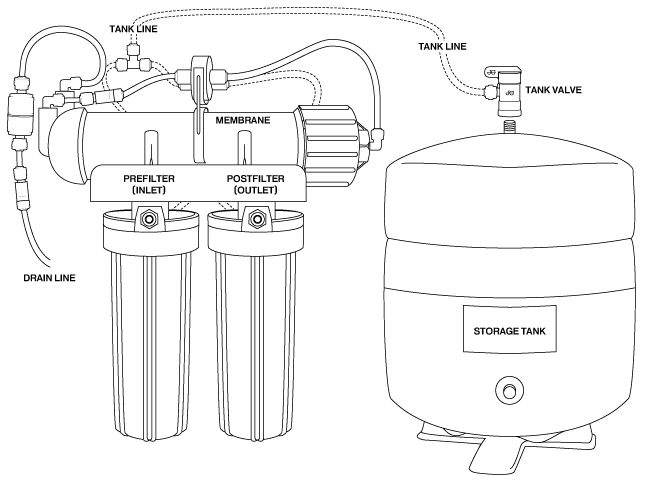
A quicker way is to turn off the valve on top of the storage tank (off is with the valve handle at right angles with the tube), then open the countertop RO faucet. The water should run at a uniform trickle or small stream. Next, turn off the faucet. Water should stop running to drain within 3 or 4 minutes. If it stops production and keeps it off, the shutoff system is working fine. Turning off the tank valve simulates a full tank.
If water continues to run with the tank valve closed, the unit needs attention. The most likely parts that need replacement are the hydraulic shutoff valve (the disc-shaped part mounted on the membrane housing that has 4 tubes) or, less likely, the check valve (one way valve) in the permeate tube. It is the small cigar-shaped item in the short tube that connects the left end of the membrane housing with the shutoff valve.
Red Flag
If the water you hear in the drain line sounds more like a rushing river than a gentle trickle and it never stops, turn off the inlet water to the unit and leave it off until a repair is made. The offending part is the flow restrictor. That’s the larger of the two cigar-shaped items in the drain tube.
Here’s a brief AI answer to the question with excellent reference notes.
According to multiple sources, lead does not enter the body through the skin during bathing or showering, even if the water contains lead1234. The US Environmental Protection Agency (EPA) and the Centers for Disease Control and Prevention (CDC) agree that human skin does not absorb lead in water2. Similarly, Health Canada states that lead will not enter the body through the skin or by breathing in vapors while showering or bathing3. The Massachusetts government also confirms that lead is not absorbed through the skin4.
However, it’s important to note that lead can enter the body if it is ingested. For example, you could accidentally swallow lead that is on your hands when you eat, drink, smoke, or apply cosmetics1. Therefore, it’s always a good idea to wash your hands thoroughly after contact with lead-contaminated water.
The War Against Lead Pipes
In announcing a significant expansion of the federal government’s efforts under the Bipartisan Infrastructure Law to get “100% of lead pipes out of the nation’s water supply, once and for all,” the EPA estimated that there are still 9.2 million water supply pipes in the nation that contain lead. It noted that most of these pipes serve older homes.

A devastating outbreak of sea lice attacking Icelandic salmon farms has led to the slaughter of countless farmed salmon and has become a major animal rights controversy. See The Guardian for full details.
The Chemical Industry Has Spent $110 million in Recent Months to Thwart Legislation to Control PFAS
The US chemical industry likely spent over $110m during the last two election cycles deploying lobbyists to kill dozens of pieces of PFAS legislation and slow administrative regulation around “forever chemicals”, a new analysis of federal lobbying documents has found.
The industry’s onslaught was effective: only eight pieces of legislation that targeted PFAS made it through Congress, the paper prepared by the Food and Water Watch (FWW) nonprofit found.
“There’s an extreme amount of money that’s going into fighting [PFAS legislation],” said Amanda Starbuck, FWW’s research director and the lead author on the report. “It’s hard to win these fights when there’s so much funding being put in from the opposing side.”
PFAS are a class of about 14,000 compounds used to make products resist water, stains and heat. They are known as “forever chemicals” because they do not naturally break down, and they have been linked to cancer, high cholesterol, liver disease, kidney disease, fetal complications and other serious health problems.
As the dangers from PFAS have come into sharper focus over the last decade, lawmakers, the Environmental Protection Agency and other administrative agencies have come under an ever-increasing amount of pressure to rein in the chemicals use and clean up pollution. Chemical manufacturers’ spending has jumped in response, the report noted
“The chemical and associated industries are powerful and have used their army of lobbyists and campaign finance war chests to thwart meaningful action,” the paper states.
Full article from The Guardian.
Measuring PFAS
A major problem in enforcing the EPA’s proposed new 4 parts per trillion limit on the “forever chemicals” is that instrumentation capable of measuring an amount that small is hard to find and very expensive. A practical solution may be to raise the allowable a bit to an amount that city water suppliers can measure. The lesson here is that all EPA allowables are based on science that has been negotiated to meet the realities of the world we live in.
Nitrates in Wells in Eastern Oregon
High levels of nitrates that are getting worse by the year are making the water impossible to drink in rural areas of Eastern Oregon.”Thousands of Oregonians in Umatilla and north Morrow counties rely on private wells for drinking water, tapping into a massive underground aquifer. But pollution has steadily contaminated that groundwater source in recent decades, turning what was once safe water into a potentially toxic supply.” KGW8 News.
“Toilet-to-Tap.” Arizona is in the process of making the switch.
It’s often referred to informally as “toilet-to-tap’’ technology. Arizonans eventually will be drinking treated sewage – what the state Department of Environmental Quality and City of Phoenix prefer to call the product of “advanced water purification’’ – for the simple reason that there just isn’t enough water to serve a growing population. Robin Silver, co-founder of the Center for Biological Diversity, said it’s not a question of “if’’ but of “when.’’ The use of reclaimed effluent is inevitable in the arid Southwest, period. That’s not really debatable anymore.’’ Capitol Media Services.
Fraudulent Claims Are Disrupting Camp LeJeune Damage Payouts
According to Bloomberg News, “The government plan to pay billions of dollars to victims of toxic water at Camp Lejeune has unleashed a wave of fraudulent claims that threatens to disrupt or taint what could be one of the largest-ever mass tort cases. Veterans’ advocates and lawyers also say the fake claims — and the time and effort to identify and weed them out — could dilute the empathy for legitimately ill victims and slow the process of compensating them.” Water Online.
A Thriving City Is Dying from Lack of Water
The gripping story of a French island city in the Indian Ocean that is literally dying of thirst. Full story.

Lithium, an unregulated water contaminant, was found in surprisingly high occurrence levels in ongoing EPA monitoring. In fact, 22% of the community water supplies tested exceeded the the EPA’s established health reference level.
According to a recent Water Quality Association (WQA) statement, “The health implications of lithium in drinking water are still being studied, and they may not all be negative. In the pharmaceutical industry, lithium is used as an antidepressant, and some studies have correlated high lithium levels in drinking water with a reduction in suicide rate. A study in Denmark had conflicting results: High levels of lithium in drinking water were correlated with a decreased risk of dementia, but medium levels of lithium in drinking water correlated with an increased risk of dementia. A study in Argentina found that high levels of lithium can interfere with child development by making it difficult for pregnant women to maintain healthy calcium levels in the blood.”
The WQA reaches the familiar conclusion: “More studies are needed.”
In the meantime, if you want to remove lithium from your drinking water, an undersink reverse osmosis unit is the best way to go about it.
Source: WQA email newsletter, November 2023.
1. The first thing of all is relieve the pressure on the housings. With a filter, turn off the inlet water and open the faucet. Leave it locked open while you work. If you have a reverse osmosis unit, also turn off the valve on the storage tank. When no water is coming from the faucet, you should be able to open the housing.
2. To open, turn the housing counterclockwise. Think of it this way: If you put the filter wrench on the extreme right housing and point the handle away from the housing to the left, you would use your right hand and pull back toward your body to open the housing.
3. Get into a comfortable position. If the unit is installed in an awkward, hard-to-reach location, you may have to pull it out to a place where you can address it comfortably. In the worst case, you may have to uninstall it so you can lay it on its back to get more leverage. (Remember that the housings are full of water, so it’s going to run on the floor when it opens if it’s lying sideways.)
4.If all else fails, you can get more leverage by lengthening the wrench handle with a pipe or a vacuum cleaner wand. Or you can even buy a special wrench designed for very tough jobs. See WR012 on this page.
5. Extreme methods: Someone suggests using a hair dryer to warm the filter cap causing it to expand and thus loosen more easily. Another suggestion, and I’ve seen this work with larger housings, is to apply the wrench to the housing and tap on the wrench handle with a small hammer or rubber mallet. The shock from the mallet tapping can break the housing loose and let you open it.
6. Finally, this may sound strange, but it is important. When you apply steady pressure to the wrench to loosen the housing, believe that it will open. In fact, think about what it will feel like when it breaks loose and opens.