



Installing A No-Backwash
Whole House Filter
Installation
This is a simple installation. No drain connection, no electrical connection, and no complicated setup. The water goes in one side and out the other.
Choosing a Location
Install the filter at a place where it will filter all water coming into the home. It must be protected from freezing and direct sunlight, and it needs a solid, level footing. Keep in mind that it will need to be disconnected and refilled with media eventually. Ideally, a sediment filter should be installed both before and after filters of this type.
Loading the Filter Media
The advanced Vortech tank used with this filter requires no gravel under-bedding, so all you have to do is pour in the granular filter carbon.
- Cover the hole in the riser tube (the 1″ pipe that comes out of the middle of the tank’s mouth) with tape or a small plastic bag to prevent media from going inside the tube during filling.
- Using the funnel provided, pour the media into the tank. Avoid breathing the dust while filling the tank. The media will fill the tank about 2/3 full.
- When the tank is filled, remove the protective tape or bag from the riser tube, and screw the filter head onto the tank. The riser tube goes though the center of the basket. You may have to push down to get the head to drop to the threads. Tighten until it’s snug, but don’t over-tighten. No tools are needed.
If there is no upper basket attached to the bottom of the inlet valve, do not install the unit the unit without it. If it isn’t pre-installed, attach the upper basket to the underside of the head.
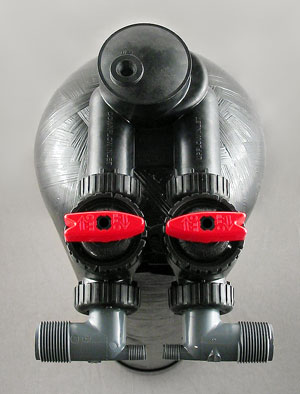
Setup and Initial Rinse
- Attach the inlet of the filter (the connection on the right) to your plumbing using standard, code-approved methods. The filter ends in a male 1″ pipe thread, so you may have to make some adaptation. If you hook the inlet and outlet backward, it won’t work right. Verify. You should be putting water into the port labelled “Uflow inlet.”
Important: Connect only the inlet side of the filter to the house plumbing initially.
- After the filter is installed to the incoming water, slowly open the inlet water to the filter so the water flows into the filter slowly, no faster than half speed. Allow the filter to fill slowly. Air will escape from the open outlet port and eventually water, probably cloudy and dark , will begin to come out of the open outlet port of the filter. The installer will have to allow enough water to run through the filter to rinse the media before the outlet port is attached to the house plumbing. If necessary, catch the water in a large bucket or other container. Let the filter rinse at half speed for four or five minutes, then open the inlet water all the way.
- Run the filter at full flow until you feel that the media has rinsed sufficiently — usually 4 or 5 minutes more — and the water is clear with no visible discoloration or media pieces. When the water runs clean, connect the outlet port of the filter to the house lines, open a downstream hose bib or the nearest faucet. Turn on the water and allow as few more gallons to rinse from the open hose bib. The filter is now installed and the water is ready to use.
For a time you may experience cloudy water (from air trapped in the lines) and air pockets. This is normal and will soon go away.

