



What Ever Happened to Lolong?
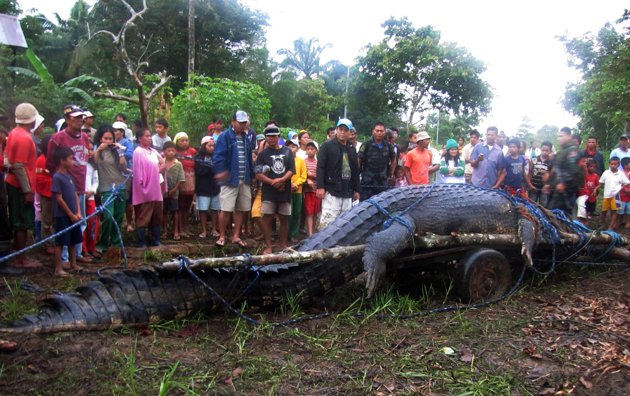
In September of 2011 we reported the capture of Lolong, the world’s largest crocodile ever held in captivity. He had just been captured in the Philippines. At the time of our writing, Lolong was on a hunger strike. What ever happened to him? The Wikipedia says:
Lolong (died 10 February 2013) was the largest crocodile ever held in captivity. He was a saltwater crocodile (Crocodylus porosus) and measured at 6.17 m (20 ft 3 in), making him one of the largest crocodiles ever measured from snout to tail, and weighing 1,075 kg (2,370 lb.).
In November 2011, British crocodile expert Adam Britton of National Geographic sedated and measured Lolong in his enclosure and confirmed him as the world’s largest crocodile ever caught and placed in captivity.
Lolong died from pneumonia and cardiac arrest, after a little over one year and five months in captivity.
EPA Drags Its Feet on Cancer-Causing Nitrate Research
The US Environmental Protection Agency (EPA) has backed off its re-assessment of cancer-causing nitrates despite decades of research suggesting the contaminant is more harmful than previously thought and that nitrate pollution is at crisis levels in US drinking water.
The agency would not confirm the assessment was cancelled, but the work has been stagnant for more than two years and the department responsible for it was eliminated. And scientists and health advocates say regardless of whether it has been cancelled or is locked in a lengthy delay, Americans are paying the price with their health. Unfortunately, the stalled assessment comes as nitrate pollution becomes more pervasive. (Circle of Blue)
EPA Withdraws Guidance for PFAS Intake for Drinking Water Suppliers
EPA has withdrawn the guidance that told states and utilities how to use the Clean Water Act to stop PFAS before it reaches a drinking water intake. In a memo dated August 11, 2026, the agency’s Office of Water identified several documents as “appropriate for rescission,” among them an April 2022 memo that directed states to use existing CWA authorities against PFAS discharges, and that laid out how EPA would handle PFAS. The withdrawal does not change a single statute. This means that while the 4 ppt regulatory statute for PFAS remains in place, it is now up to drinking water providers to test and assure compliance. (WaterVerge)
Homeless People and Four Dogs Living in Sewer Rescued from Rising Water in San Bernardino CA
Rising flood waters trapped homeless residents in a sewer pipe. The YouTube video of their rescue is worth watching. (ABC News)
Wastewater Pollution from Data Centers
Little has been said until now about growing concerns of significant pollution of wastewater from data centers. Attention has been directed at the quantities of water use and little has been said about the centers’ effect on water quality. A Guardian study addresses alarming findings in data center wastewater. Among the items of concern in the highly polluted water range from rare bacteria to “forever chemicals.” (The Guardian.)
Camp Lejeune Cancer Victims Will Get Treatment, If the Republicans Win the Election
President Trump promised at a political rally that veterans who got cancer from drinking the contaminated drinking water at Camp Lejeune will get treatment at veterans’ hospitals if the Republicans win in the November mid-term election. The water at Camp Lejeune was severely contaminated for many years and the U.S. military knew of the contamination but hid the problem
University Research Finds that Plastic Particles Become Much More Dangerous to Humans and Animals When Exposed to Water
Plastics are supposed to be chemically inert. It’s the reason they’re used so frequently to package food, bottle water, and create children’s toys: They’re safe.
But something important happens when a large piece of plastic fragments into micro- and nanoparticles. Its surface area increases dramatically relative to its volume. Vastly more of the material is now exposed to its surroundings.
A new study by researchers from Columbia University and the University of California, Berkeley, found that this newly created surface is not necessarily safe, and identified the chemical reasons why.
“As plastic fragments into smaller and smaller particles, its surface area increases enormously. Then microplastics change the water that surrounds them, generating high-energy, reactive radicals (reactive oxygen species, ROS) that very likely contribute to biological damage that we see in animals and potentially in humans as a result of microplastic exposure,” said Wei Min, a Columbia professor of Chemistry and Biomedical Engineering.
“Our research found that when microplastics interact with water, as they do when they’re in bottled water, or when they’re absorbed into our bloodstream, they spontaneously generate what we call reactive oxygen species (ROS),” said Naixin Qian, a postdoctoral researcher in Wei Min’s lab who helped lead the research. “ROS are textbook examples of the kinds of molecules that can damage animal and human tissue.” (Full article from Columbia University.)
Food Scarcity Is Much More Severe in Land-Locked Regions
Water scarcity has emerged as a leading factor for food insecurity in landlocked developing countries, especially in central Asia. In areas where food can be brought in by water it is more abundant than areas that depend on more expensive overland transportation. (Circle of Blue)
Serious Water Pollution from Melting Ice Due to Global Warming
Tap water in one of the world’s northernmost towns is no longer drinkable, the Guardian reports. It’s a result of rapidly thawing permafrost releasing toxic heavy metals into the community supply.
Longyearbyen, a municipality in Svalbard, Norway, is one of the fastest-warming places in the world. Located just 800 miles from the North Pole, temperatures there are rising between five and seven times the global average. Melting permafrost exposes underlying bedrock to the open air; pyrite, also known as fool’s gold, generates acid in such conditions, which is leaking into waterways. This includes those that feed a 1.5 mile-long lake, called Isdammen, Longyearbyen’s main source of drinking water.
Manganese levels in the supply were found to be 25 times higher than levels determined safe by the Norwegian Institute of Public Health. Sulphate and nickel levels have also spiked, adding further urgency to the issue. Harsh winter conditions, officials say, complicate possible solutions, which include the installation of a desalination plant or other filtering technologies. (Circle of Blue)
Canadian pro cliff diver Molly Carlson makes history as she becomes first woman to dive off iceberg
Carlson made history when she dove off the top of an iceberg and into the Atlantic Ocean – becoming the first woman to accomplish the bone-chilling feat as she declared it was the “best day of my life.”
The 28-year-old Canadian completed the nearly 50-foot dive on June 11 off the coast of Newfoundland, Canada, after she was inspired by her experience with mental health challenges to push herself. Yahoo Sports
Germany Launches Cleanup to Remove Dumped Munitions From WWI and WWII
Germany has embarked on an immediate project to recover tons of munitions that were scattered on the floor of the North and Baltic seas at the end of World Wars I and II. The discarded bombs and shells are becoming a threat to the marine environment due to the release of toxic chemicals.
More than 1.5 million tons of ordnance were intentionally dumped in German waters at the end of WWII, with around 300,000 tons of unexploded ordnance lying in the German Baltic Sea and the rest in the German North Sea. Maritime Executive.
Ultra-endurance swimmer Catherine Breed becomes the first person to swim the entire coastline of California.
Breed swam for 4 months, from the northern-most tip of California to the Mexican border. The 33-year-old from San Francisco spent more than 15 weeks in the water. (Guardian)

